RKS-7000Q - Home Theater LG - Free user manual and instructions
Find the device manual for free RKS-7000Q LG in PDF.


User questions about RKS-7000Q LG
0 question about this device. Answer the ones you know or ask your own.
Ask a new question about this device
Download the instructions for your Home Theater in PDF format for free! Find your manual RKS-7000Q - LG and take your electronic device back in hand. On this page are published all the documents necessary for the use of your device. RKS-7000Q by LG.
USER MANUAL RKS-7000Q LG
Before connecting, operating or adjusting this product, please read this instruction booklet carefully and completely.
The working life of this product is 7 years since the date of purchase.

CAUTION
RISK OF ELECTRIC SHOCK DO NOT OPEN

CAUTION: TO REDUCE THE RISK OF ELECTRIC SHOCK
DO NOT REMOVE COVER (OR BACK) NO USER-SERVICEABLE PARTS INSIDE REFER SERVICING TO QUALIFIED SERVICE PERSONNEL.

This lightning flash with arrowhead symbol within an equilateral triangle is intended to alert the user to the presence of uninsulated dangerous voltage within the product's enclosure that may be of sufficient magnitude to constitute a risk of electric shock to persons.

The exclamation point within an equilateral triangle is intended to alert the user to the presence of important operating and maintenance (servicing) instructions in the literature accompanying the product.
WARNING: TO PREVENT FIRE OR ELECTRIC SHOCK HAZARD, DO NOT EXPOSE THIS PRODUCT TO RAINN OR MOSITURE.
WARNING: Do not install this equipment in a confined space such as a bookcase or similar unit.
CAUTION: Do not block any ventilation openings. Install in accordance with the manufacturer's instructions.
Slots and openings in the cabinet are provided for ventilation and to ensure reliable operation of the product and to protect it from over heating.
The openings should be never be blocked by placing the product on a bed, sofa, rug or other similar surface. This product should not be placed in a built-in installation such as a bookcase or rack unless proper ventilation is provided or the manufacturer's instruction have been adhered to.

CAUTION:
CLASS 3B VISIBLE AND INVISIBLE LASER RADIATION WHEN OPEN AND INTERLOCKS DEFEATED AVOID EXPOSURE TO THE BEAM.
CAUTION:
This product employs a Laser System.
To ensure proper use of this product, please read this owner's manual carefully and retain it for future reference. Should the unit require maintenance, contact an authorized service center.
Use of controls, adjustments or the performance of procedures other than those specified herein may result in hazardous radiation exposure.
To prevent direct exposure to laser beam, do not try to open
the enclosure. Visible laser radiation when open. DO NOT STARE INTO BEAM.
CAUTION: The apparatus should not be exposed to water (dripping or splashing) and no objects filled with liquids, such as vases, should be placed on the apparatus.
CAUTION concerning the Power Cord
Most appliances recommend they be placed upon a dedicated circuit;
That is, a single outlet circuit which powers only that appliance and has no additional outlets or branch circuits. Check the specification page of this owner's manual to be certain.
Do not overload wall outlets. Overloaded wall outlets, loose or damaged wall outlets, extension cords, frayed power cords, or damaged or cracked wire insulation are dangerous. Any of these conditions could result in electric shock or fire. Periodically examine the cord of your appliance, and if its appearance indicates damage or deterioration, unplug it, discontinue use of the appliance, and have the cord replaced with an exact replacement part by an authorized servicer.
Protect the power cord from physical or mechanical abuse, such as being twisted, kinked, pinched, closed in a door, or walked upon. Pay particular attention to plugs, wall outlets, and the point where the cord exits the appliance.
To disconnect power from the mains, pull out the mains cord plug. When installing the product, ensure that the plug is easily accessible.

Disposal of your old appliance
-
When this crossed-out wheeled bin symbol is attached to a product it means the product is covered by the European Directive 2002/96/EC.
-
All electrical and electronic products should be disposed of separately from the municipal waste stream via designated collection facilities appointed by the government or the local authorities.
-
The correct disposal of your old appliance will help prevent potential negative consequences for the environment and human health.
-
For more detailed information about disposal of your old appliance, please contact your city office, waste disposal service or the shop where you purchased the product.
Contents
Introduction 4-9
Symbol Used in this Manual 4
Notes on Discs 4
Recordable and Playable Discs .....5
Playable Discs 6
Regional Code 6
Playing Media Files Using the USB Feature ....7
Front Panel....8
Touch Pad Operation 8
Remote Control 9
Hookup and Settings .....10-23
Rear Panel 10
Remote Control Operation 10
Connections to Your TV .....11
Connecting to an Amplifier .....12
Accessory Audio/Video (A/V) Connections ..13-14
Connecting to the Aerial 14
Using the Home Menu 15
Initial Settings 15
General Settings 15-17
Auto Programming .....15
Program Edit 16
AV1 Decoder....16
Clock Set 17
TV Aspect 17
Display Mode 17
AV2 Connection .....17
Progressive Scan 17
Video Output Format 17
Power Save Mode .....17
Initialization 17
Language Settings 18
Audio Settings 18
Dolby Digital / DTS / MPEG 18
Sampling Frequency 18
DRC (Dynamic Range Control) .....18
Vocal....18
Lock (Parental Control) Settings .....19-20
Set Password / Rating / Area Code .....19
DivX Registration Code 19
KARAOKE Registration 20
Recording Settings 21
Record Mode Set 21
Record Aspect 21
DV Recording Audio .....21
Auto Chapter 21
Disc Settings .....21-22
Disc Format ....21
Finalize 22
Disc Label 22
Disc Protect 22
PBC 22
General Explanation of On-Screen Display ....23
Playback ....24-32
General Playback Features .....24-27
Playing a DivX Movie File 28
Playing an Audio CD or MP3/WMA file .....29
Program Playback with Audio CD and
MP3/WMA file ....30
Viewing a JPEG File 31-32
Recording 33-38
About DVD recording 33
Basic Recording from a TV .35
Instant Timer Recording .....35
Timer Recording 36
Checking Timer Recording Details .....37
Recording from an External Input ....37
Recording from DV Input 38
Editing 39-45
Title List and Chapter List Menu Overview ....39
VR Mode: Original and Playlist Editing .....40
Adding Chapter Markers 40
Changing Title Thumbnails ....40
Making a New Playlist....41
Adding Additional Title/Chapters to the Playlist .41
Deleting an Original or Playlist Title/Chapter . . .42
Deleting a Part ....42
Naming a Title .43
Dividing One Titles Into Two 44
Combining Two Chapters Into One .....44
Moving a Playlist Chapter . . . . . . . . . . . . . . . . . . . . . . . . . . 45
Hiding a Chapter 45
Protecting a Title .45
Reference 46-59
Additional Information 46
Overwriting Recording 46
Viewing Title List menu displayed on other
DVD Recorders or Players .....46
Playing Your Recordings on Other DVD
Players (Finalizing a Disc) 46
Language Codes 47
Area Codes 47
Operation with KARAOKE .....48-55
Controlling Your TV with the Supplied Remote
Control 56
Troubleshooting 57-58
Specifications 59
Introduction
To ensure proper use of this product, please read this owner's manual carefully and retain it for future reference.
This manual provides information on the operation and maintenance of your recorder. Should the unit require service, contact an authorized service location.
Symbol Used in this Manual

The lightning flash symbol alerts you to the presence of dangerous voltage within the product enclosure that may constitute a risk of electric shock.

The exclamation point alerts you to the presence of important operating and maintenance / servicing instructions.

Indicates hazards likely to cause harm to the unit itself or other material damage.
Note:
Indicates special notes and operating features.
Tip:
Indicates tips and hints for making the task easier.
A section whose title has one of the following symbols are applicable only to the disc represented by the symbol.
DVD ALL All DVD discs listed below.
RAM DVD-RAM disc
-RWVR DVD-RW with VR recording mode
-RWvideo DVD-RW with Video recording mode
+RW DVD+RW disc
-R DVD-R disc
+R DVD+R (DL) disc
DVD DVD-Video disc
VCD Video CDs
ACD Audio CDs
DivX DivX files
MP3 MP3 files
WMA WMA files
JPEG JPEG files
About the Symbol Display
" may appear on your TV display during operation and indicates that the function explained in this owner's manual is not available on that specific media.
Notes on Discs
Handling Discs
Do not touch the playback side of the disc. Hold the disc by the edges so that fingerprints do not get on the surface. Never stick paper or tape on the disc.


Storing Discs
After playing, store the disc in its case. Do not expose the disc to direct sunlight or sources of heat and never leave it in a parked car exposed to direct sunlight.
Cleaning Discs
Fingerprints and dust on the disc can cause poor picture quality and sound distortion. Before playing, clean the disc with a clean cloth. Wipe the disc from the center out.

text_image
Diagram showing two hand positions on a circular object, one with rotation arrow and the other with cross, labeled with 'O' and '×'Do not use strong solvents such as alcohol, benzine, thinner, commercially available cleaners, or anti-static spray intended for older vinyl records.
Moisture Condensation
Never operate this product immediately after moving it from a cold location to a warm location. Leave it for two or three hours without operating it. If you use this product in such a situation, it may damage discs and internal parts.
Recordable and Playable Discs

DVD-RW (Digital Video Disc - ReWritable):
- DVD-RW discs can be formatted for VR mode recording or Video mode recording.
- These Discs can be recorded on repeatedly. Recordings can be erased, then you can record again on the same Disc.
[VR mode]
• Recordings can be extensively edited - Playable only on VR mode compatible players (after finalization)
[Video mode] - Playable on regular DVD players (after finalization)
- Limited editing features

DVD-R (Digital Video Disc - Recordable)
• These Discs can be recorded only once. After you finalize a DVD-R, you cannot record on it or edit it.
• DVD-R discs can be only formatted to Video mode.
- Playable on regular DVD players (after finalization)
- Limited editing features

DVD-RAM (DVD - Random Access Memory)
• DVD-RAM discs can be formatted for VR mode recording
- These Discs can be recorded on repeatedly. Recordings can be erased, then you can record again on the same Disc.
- Playable on DVD-RAM compatible players.
• Recordings can be extensively edited.
- Only DVD-RAM standard Version 2.0, 2.1 and 2.2 discs can be used in this unit.
- You cannot use the cartridge-type DVD-RAM disc in this unit.

DVD+RW (Digital Video Disc + ReWritable)
- These Discs can be recorded on repeatedly. Recordings can be erased, then you can record again on the same Disc.
- Playable on DVD+RW compatible players (automatically finalization)
- The edited contents are playable on DVD+RW compatible players only after finalization
• Recordings can be edited the title/chapter

DVD+R (Digital Video Disc + Recordable)
- These Discs can be recorded only once. After you finalize a DVD+R, you cannot record on it or edit it any more.
- Playable on DVD+R compatible players (after finalization)
- Any edited contents are not be compatible on DVD+R compatible players. (Hide, chapter combine, added chapter mark, etc.)
- Limited title/chapter editing features.

DVD+R DL (Digital Video Disc + Recordable; Double Layer)
- These Discs can be recorded only once. After you finalize a DVD+R DL, you cannot record on it or edit it any more.
- Storage space is nearly doubled with double layer DVD+R media, allowing consumers to record up to 8.5GB of video on a single DVD+R disc.
- Playable on DVD+R DL compatible players (after finalization)
- Any edited contents are not be compatible on DVD+R DL compatible players. (Hide, chapter combine, added chapter mark, etc.)
- Limited title/chapter editing features.
Recommended recordable DVD discs
DVD-R DVD+R DVD-RW DVD+RW DVD+R(DL) DVD-RAM
| Mitsubishi (8x, 16x) Mitsubishi (8x, 16x) Mitsubishi (4x) Mitsubishi (4x) Mitsubishi (2.4x) Fujifilm (2x) | |||||
| That's (8x, 16x) | Ricoh (8x, 16x) | Verbatim (4x) | SONY (2.4x) | Maxell (2.4x) | Mitsubishi (3x) |
| Verbatim (8x) | Verbatim (8x) | JVC (4x) | Verbatim (2.4x) | - | - |
| - | - | Victor (4x) | Ricoh (2.4x, 4x) | - | - |
| - | - | Maxell (4x) | - | - | - |
Note:
If a DVD-RW/DVD+RW discs is recorded using a personal computer or other recorder, you cannot format the disc using this recorder. So if you want to use the disc on this recorder, you must format the disc using the original recorder.
playable Discs

DVD (8 cm / 12 cm disc)
VIDEO
• Discs such as movies that can be purchased or rented

Video CD (VCD) (8 cm / 12 cm disc)
• VIDEO CDs or CD-Rs/CD-RWs in VIDEO CD/Super VIDEO CD format

Audio CD (8 cm / 12 cm disc)
• Music CDs or CD-Rs/CD-RWs in music CD format that can be purchased

CD-R/CD-RW (8 cm / 12 cm disc)
- CD-R/CD-RW discs that contain audio titles, DivX, MP3, WMA, or JPEG files.
Notes:
- Depending on the conditions of the recording equipment or the CD-R/RW (or DVD±R/RW) disc itself, some CD-R/RW (or DVD±R/RW) discs cannot be played on the unit.
- Do not attach any seal or label to either side (the labeled side or the recorded side) of a disc.
- Do not use irregularly shaped CDs (e.g., heart-shaped or octagonal). Doing so may result in malfunctions.
- Depending on the recording software & the finalization, some recorded discs (CD-R/RW or DVD±R/RW) may not be playable.
- DVD-R/RW, DVD+R/RW and CD-R/RW discs recorded using a personal computer or a DVD or CD Recorder may not play if the disc is damaged or dirty, or if there is dirt or condensation on the Recorder's lens.
- If you record a disc using a personal computer, even if it is recorded in a compatible format, there are cases in which it may not play because of the settings of the application software used to create the disc. (Check with the software publisher for more detailed information.)
- This recorder requires discs and recordings to meet certain technical standards in order to achieve optimal playback quality. Pre-recorded DVDs are automatically set to these standards. There are many different types of recordable disc formats (including CD-R containing MP3 or WMA files) and these require certain pre-existing conditions (see above) to ensure compatible playback.
- Customers should note that permission is required in order to download MP3 / WMA files and music from the Internet. Our company has no right to grant such permission. Permission should always be sought from the copyright owner.
Regional Code
This unit has a regional code printed on the rear of the unit. This unit can play only DVD discs labeled same as the rear of the unit or "ALL".
Notes on Regional Codes
- Most DVD discs have a globe with one or more numbers in it clearly visible on the cover. This number must match your unit's regional code or the disc cannot play.
- If you try to play a DVD with a different regional code from the unit, the message "Incorrect region code. Can't play back" appears on the TV screen.
Playing media files using the USB feature
You can enjoy the media files such as pictures (JPEG), movies (DivX) and tunes (MP3/WMA) saved in an MP3 player or USB memory by connecting the storage device to the USB port of this unit.
- Connect the USB device to the USB port of the unit.
- Press HOME on the remote control.
- Select [MUSIC], [PHOTO] or [MOVIE] option. Details for the options are the page 15.
Compatible Devices
- Devices which require additional program installation when you have connected it to a computer, are not supported.
- MP3 Player: Flash type MP3 player.
- The MP3 player requiring installation of a driver is not supported.
- USB Flash Drive: Devices that support USB2.0 or USB1.1.
Notes:
- Do not extract the USB device in operating (play, copy, move, etc.).
- A back-up demands to prevent a data damage.
- If you use a USB extension cable or USB hub, the USB device might not be recognized.
• This unit can support USB 2.0 or USB 1.1. - A device using NTFS file system is not supported. (Only FAT (16/32) file system is supported.)
- The USB function of this unit does not support all USB devices.
• Digital camera and mobile phone are not supported. - This unit is not supported when the total number of files is 1000 or more.
- DivX playback on USB may not be perfect for high bit rate content.
- When resetting this unit, remove the USB devie from the USB port of this unit.
Front Panel

text_image
1 2 3 4 5 6 7 8 9 10 11 12 131 POWER
Switches the unit ON or OFF.
2 Disc Tray
Insert a disc here.
3 Remote Sensor
Point the recorder remote control here.
4 Display window
Shows the current status of the recorder.
REC: The recorder is recording.
DVD: The recorder is DVD mode.
⑨: Indicates when the recorder is in timer recording or a timer recording is programmed.
: Indicates clock, total playing time, elapsed time, title number, volume, chapter/track number, channel, etc.
5 USB
Connect it to a USB port of multimedia (USB memory etc.)
6 DV IN
Connect the DV output of a digital camcorder.
7 MIC 1/MIC 2
Connect a microphone to MIC 1 or MIC 2 or to both sockets.
8 ▲ (OPEN/CLOSE)
Opens or closes the disc tray.
9 ■ (STOP)
Stops playback or recording.
10 ▶ / II (PLAY / PAUSE)
Starts playback. Pause playback or recording temporarily, press again to exit pause mode.
11 ● (REC)
Starts recording. Press repeatedly to set the recording time.
12 PR ▼/▲
- Scan up or down through memorized channels. - Selects menu options.
13 MICROPHONE VOLUME CONTROL
Tap + to increase microphone sound level, or tap - to decrease microphone sound level.
Touch Pad Operation
The buttons from 8 to 13 are touch pad buttons that are operated with brief touch.
When you operate the button on the touch pad, you should follow the directions as below.
- Touch any button on the touch pad. The LEDs on the touch pad light up.
- Touch the button you want to operate. The LEDs on the touch pad will be off in 10 seconds after the operation.
Precautions in using the touch pad
- The LEDs on the touch pad lights only when the power of the unit is on.
• Use the touch pad with clean and dry hands. - Do not press the button on the touch pad with too much force.
- Do not touch the button on the touch pad with any conductive material such as metallic object. It may cause a malfunction.
Remote Control

text_image
POWER Switches the unit ON or OFF. AV Changes the input to use for recording. (Tuner, AV1, AV2, AV 3 or DV). PIP Selects PIP function on or off. THUMBNAIL Selects a thumbnail picture. ● REC Starts recording. Press repeatedly to set the recording time. TIMER REC Displays Timer Record menu. AUDIO/MO.ST/MALE, FEMALE - Selects an audio language or audio channel. - Selects the men's or women's key. SCAN (◄◄/►►) / TEMPO(-/+) - Search backward or forward. - Adjusts the speed of song. SKIP (I◄◄ / ►►I) / KEY CONTROL (b/#) - Go to next chapter or track. Returns to beginning of current chapter or track or go to previous chapter or track. - Adjusts the key to suit your vocal range. TITLE Displays the disc's Title menu, if available. MENU/LIST Accesses menu on a DVD disc. Switches between Title List-Original and Title List-Playlist menu. HOME Accesses or removes the HOME menu. PR (+/-) Select programme of TV. ◄► ▲▼ (left/right/up/down) Selects menu options. ENTER Confirms menu selections. 0-9 numerical buttons Selects numbered options in a menu. CLEAR Removes a mark on the Marker Search menu. PROGRAM Reserves the songs. POWER OPEN/CLOSE (▲) Opens and closes the disc tray. TV/DVD To view channels selected by the recorder tuner or by the TV tuner. REPEAT Repeat chapter, track, title or all. A-B Repeats sequence between two points (A and B). CHP ADD Inserts a chapter marker when playing/ recording. REC MODE Selects the recording mode: XP, SP, LP or EP. INSTANT SKIP Skips 15 seconds forward during playback. SUBTITLE/SHADOW - Selects a subtitle language. - Displays the shadow image in song's subtitle. * Feature is not available. ZOOM Enlarges video image. STOP (■) Stops playback or recording. PLAY (►) Starts playback. PAUSE/STEP (III) Pause playback or recording temporarily. DISPLAY Accesses On-Screen Display. Displays information while viewing a TV program. RETURN (◆▼) Removes the menu. MIC VOL Adjusts the microphone volume. ECHO Mode Adjusts the echo volume. S2V Displays S2V_SCORE menu. MARKER/SEARCH - Marks any point during playback. - Displays Marker Search menu. TV Control Buttons See page 56Hookup and Settings
Rear Panel
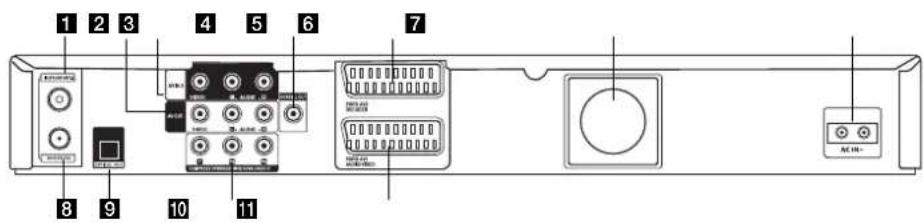
text_image
1 2 3 4 5 6 7 8 9 10 111 IN(FROM ANT.)
Connect the aerial to this terminal.
2 AV OUT (VIDEO / AUDIO OUT (Left/Right))
Connect to a TV with video/audio inputs.
3 AV IN 3 (VIDEO IN/AUDIO IN (Left/Right))
Connect the audio/video output of an external source (Audio system, TV/ Monitor, VCR, Camcorder, etc.).
4 COAXIAL OUT(Digital audio out Jack)
Connect to digital (coaxial) audio equipment.
5 EURO AV 2 DECODER
Connect the audio/video output of an external source (Pay-TV decoder, Set Top Box, VCR, etc.).
6 Cooling fan
7 AC Power Cord
Plug into the power source.
8 OUT(TO TV)
Passes the signal from the AERIAL to your TV/monitor
9 OPTICAL OUT(Digital audio out jack)
Connect to digital (optical) audio equipment.
10 COMPONENT/PROGRESSIVE SCAN VIDEO OUT (Y Pb Pr)
Connect to a TV with Y Pb Pr inputs.
11 EURO AV 1 AUDIO/VIDEO
Connect to a TV with SCART jack.
Remote Control Operation
Point the Remote Control at the remote sensor and press the buttons.

Do not mix old and new batteries. Never mix different types of batteries (standard, alkaline, etc.).
Remote Control Battery Installation
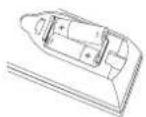
Remove the battery cover on the rear of the Remote Control, and insert two (size AA) batteries with + and - matched correctly.
Connections to Your TV
• Make one of the following connections, depending on the capabilities of your existing equipment.
- When using the COMPONENT/ PROGRESSIVE SCAN VIDEO OUT jacks, set Video Output Format to [YPbPr] on setup menu. When using the SCART jack, set the mode to [RGB] on it.
Tips
- Depending on your TV and other equipment you wish to connect, there are various ways you could connect the recorder. Use only one of the connections described below.
- Please refer to the manuals of your TV, VCR, Stereo System or other devices as necessary to make the best connections.
Caution
• Make sure the recorder is connected directly to the TV. Tune the TV to the correct video input channel.
- Do not connect the recorder's AUDIO OUT jack to the phono in jack (record deck) of your audio system.
- Do not connect your recorder via your VCR. The DVD image could be distorted by the copy protection system.
Rear of TV
text_image
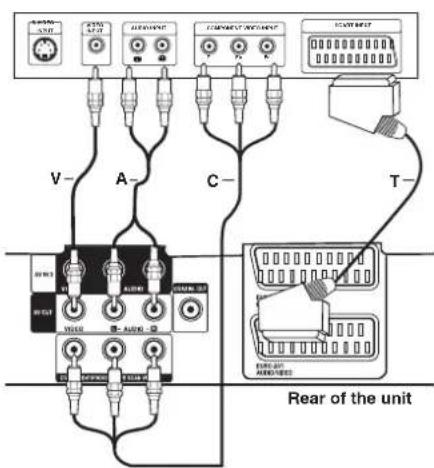
A B C D V T Rear of the unitVideo connection
Connect the VIDEO OUT jack on the recorder to the video in jack on the TV using the video cable (V).
Audio (Left/Right) Connection
Connect the left and right AUDIO OUT jacks of the recorder to the audio left and right IN jacks on the TV using the audio cables (A). Do not connect the recorder's AUDIO OUT jack to the phono in jack (record deck) of your audio system.
Component Video connection
Connect the COMPONENT / PROGRESSIVE SCAN VIDEO OUT jacks on the recorder to the corresponding input jacks on the TV using an Y Pb Pr cable (C).
If your television is a high-definition or "digital ready" television, you may take advantage of the recorder's progressive scan output for the highest video resolution possible. If your TV does not accept the Progressive Scan format, the picture will appear scrambled if you try Progressive Scan on the recorder.
- Set the resolution to 576p for progressive signal using the RESOLUTION on the remote control.
Note:
Progressive scan does not work with the analog video connections (yellow VIDEO OUT jack).
SCART connection
Connect the EURO AV1 AUDIO/VIDEO scart jack on the recorder to the corresponding in jacks on the TV using the scart cable (T).
Caution
Once the setting for Progressive Scan output is entered, an image will only be visible on a Progressive Scan compatible TV or monitor. If you set Progressive Scan to [ON] in error, you must reset the recorder. First, remove the disc in the recorder. Next, press STOP (■) and hold it for five seconds before releasing it. The video output will be restored to the standard setting, and a picture will once again be visible on a conventional analog TV or monitor.
Connecting to an Amplifier
Connecting to an amplifier equipped with two channel analog stereo or Dolby Pro Logic II/Pro Logic
Connect the Left and Right AUDIO OUT jacks on the recorder to the audio left and right in jacks on your amplifier, receiver, or stereo system, using the audio cables (A).
Connecting to an amplifier equipped with two channel digital stereo (PCM) or to an Audio/Video receiver equipped with a multi-channel decoder (Dolby Digital™, MPEG 2, or DTS)
- Connect one of the recorder's DIGITAL AUDIO OUT jacks (OPTICAL O or COAXIAL X) to the corresponding in jack on your amplifier. Use an optional digital (optical O or coaxial X) audio cable.
- You will need to activate the recorder's digital output. (See "Audio Settings" on page 18).
Digital Multi-channel sound
A digital multi-channel connection provides the best sound quality. For this you need a multi-channel Audio/Video receiver that supports one or more of the audio formats supported by your recorder (MPEG 2, Dolby Digital and DTS). Check the receiver manual and the logos on the front of the receiver.

Caution
Due to the DTS Licensing agreement, the digital output will be in DTS digital out when DTS audio stream is selected.
Notes:
- If the audio format of the digital output does not match the capabilities of your receiver, the receiver will produce a strong, distorted sound or no sound at all.
– Six Channel Digital Surround Sound via digital connection can only be obtained if your receiver is equipped with a Digital Multi-channel decoder. - To see the audio format of the current DVD in the on-screen display, press AUDIO.
- This recorder does not perform internal (2 channel) decoding of a DTS sound track. To enjoy DTS multi channel surround, you must connect this recorder to a DTS compatible receiver via one of this recorder's digital audio outputs.

text_image
Rear of the unit A-XO AUDIO INPUT INITIAL INPUT OPTIONAL INPUTAmplifier (Receiver)
Manufactured under license from Dolby Laboratories. "Dolby", "Pro Logic", and the double-D symbol are trademarks of Dolby Laboratories.
"DTS" and "DTS Digital Out" are trademarks of Digital Theater Systems, Inc.
Accessory Audio/Video (A/V) Connections
Connecting a PAY-TV/Canal Plus Decoder
You can watch or record PAY-TV/Canal Plus programmes if you connect a decoder (not supplied) to the recorder. Disconnect the recorder's mains lead from the mains when connecting the decoder.
To watch or record PAY-TV/Canal Plus programmes, set [AV2 Connection] option to [Decoder] (see page 17) and set the program's [Decoder On/Off] option to [On] on the Setup menu (page 16).
Tip:
You do not need to turn on the recorder to view the signals from the connected tuner on your TV.
Note:
If you disconnect the recorder's mains lead, you will not be able to view the signals from the connected decoder.

text_image
TV PAY-TV/Canal Plus Decoder SCART AV AVTS 3 VIDEO AUDIO SIGNAL OUT AVS OUT VIDEO AUDIO SYNC/TRANSFORM/SAN VESI 1 SYNC/TRANSFORM/SAN VESI 2 SYNC/TRANSFORM/SAN VESI 3Rear of the unit
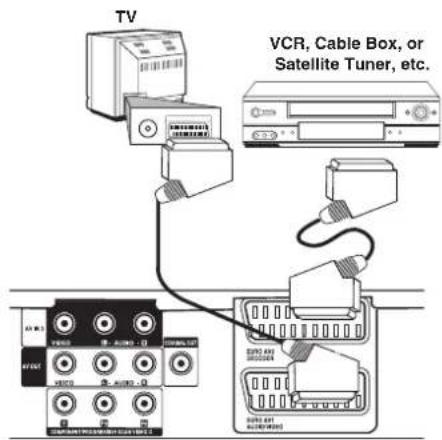
Connecting to the EURO AV2 DECODER jack
Connect a VCR or similar recording device to the EURO AV2 DECODER jack of this recorder.
To watch or record the source from EURO AV2 DECODER jack, set [AV2 Connection] option to [Others] (see page 17)
text_image
TV VCR, Cable Box, or Satellite Tuner, etc.Rear of the unit
Tip:
You do not need to turn on the recorder to view the signals from the connected tuner on your TV.
Notes:
- Pictures containing copy protection signals that prohibit any copying cannot be recorded.
- If you pass the recorder signals via the VCR, you may not receive a clear image on your TV screen. Be sure to connect your VCR to the recorder and your TV in the order shown below. To watch video tapes, watch the tapes through a second line input on your TV.
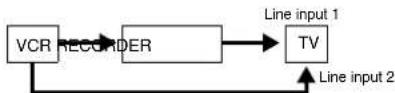
- When you record to a VCR from this recorder, do not switch the input source to TV by pressing the TV/DVD button on the remote.
- If you are using a B Sky B tuner, be sure to connect the tuner's VCR SCART jack to the EURO AV2 DECODER jack.
- If you disconnect the recorder's mains lead, you will not be able to view the signals from the connected VCR or tuner.
Connecting to the AV IN 3 Jacks
Connect the input jacks (AV IN 3) on the recorder to the audio/video out jacks on your accessory component, using audio/video cables.
Jack panel of Accessory Component (VCR, Camcorder, etc.)

text_image
Diagram showing audio signal connection between two audio equipment modules with labeled ports and connectorsRear of the unit
Connecting a Digital Camcorder
Using the front panel DV IN jack, it is possible to connect a DV digital camcorder and digitally transfer DV tapes to DVD.
Use a DV cable (not supplied) to connect the DV in/out jack of your DV camcorder to the front panel DV IN jack of this recorder.
Note:
This jack is for connection to DV digital camcorder only. It is not compatible with digital satellite tuners or D-VHS video decks.

text_image
Front of the unit DV Digital CamcorderConnecting to the Aerial
Remove the aerial cable plug from your TV set and insert it into the aerial socket at the back of the recorder. Plug one end of the aerial cable into the TV socket on the recorder and the other end into the aerial input socket on your TV set.
RF coaxial connection
Connect the OUT jack on the unit to the aerial input jack on the TV using the 75-ohm Coaxial Cable supplied (R). The OUT jack passes the signal through from the AERIAL jack.

text_image
Aerial Rear of TV Aerial R AV R1 AV OUT AV OUT AV OUT AV OUT AV OUT AV OUT AV OUT AV OUT AV OUT AV OUT AV OUT AV OUT AV OUT AV OUT AV OUT AV OUT AV OUT AV OUT AV OUT AV OUT AV OUT AV OUT AV OUT AV OUT AV OUT AV OUT AV OUT AV OUT AV OUT AV OUT AV OUT AV OUT AV OUT AV OUTRear of the unit
Using the Home Menu
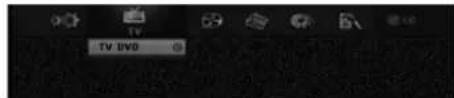
From the Home Menu screen you can access all the Media for playback and recording of the recorder.
- Press HOME to display the Home Menu screen.
- Use the ◀/▶ buttons to select a main option you want. Sub options appears.
- Use the ▲ / ▼ and ENTER buttons to select the sub option you want.
text_image
TV TV DVD- To exit the HOME menu, press HOME.
TV
• TV DVD: Returns to live TV viewing for DVD recording.
MOVIE
• DISC:
- Displays Title List menu for recordable disc (page 39)
- Displays [Movie List] menu for DivX disc. (page 28)
- Plays back Video CD or DVD-Video disc (page 24-27).
• USB Divx: Displays the [Movie List] for USB device (page 28)
PHOTO (page 31-32)
• DISC: Displays [Photo List] menu for disc.
- USB: Displays the [Photo List] for USB device.
MUSIC (page 29-30)
• DISC: Displays [Music List] (or Audio CD) menu for disc.
- USB: Displays the [Music List] for USB device.
KARAOKE (page 48-55)
• DISC: Displays [KARAOKE] menu for disc.
- USB: Displays the [KARAOKE] for USB device.
SETUP (page 15)
• Start: Displays Setup menu.
Initial Settings
In this menu system, there are several ways to customize the settings provided. Most menus consist of three levels to set up the options, but some require greater depth for the variety of settings.
General Operation
- Select [SETUP] and press ENTER. Setup menu appears.
- Use ▲ / ▼ to select the desired option.
- While the desired item is selected, press ▶ to move to the second level.
- Use ▲ / ▼ to select the second desired option.
- Press ▶ to move to the third level.
- Use ▲ / ▼ to select the desired setting then press ENTER to confirm your selection. Some items require additional steps.
- Select [SETUP] and then press ENTER to exit the Setup menu.
Note:
Press ◀ to go back to the previous level.
General Settings
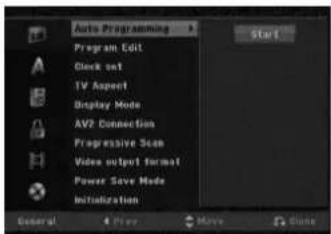
Auto Programming
This recorder is equipped with a frequency synthesized tuner capable of receiving up to 88 TV channels.
Preparation:
- Connect the recorder to the desired type of aerial, as shown in Connecting to the Aerial on page 14.
text_image
Auto Programming Program Edit Clock set 1V Aspect Display Mode AV2 Connection Progressive Scan Video output format Power Save Mode Initialization Start General 4 Play Move Close- Select the [Auto Programming] option.
- Press ▶ to move to the third level. [Start] icon is highlighted.
- Press ENTER to begin the channel search. The tuner will automatically cycle through all available channels in the area and place them in the tuner's memory.
Note:
After you have connected your recorder for the very first time. If you select [SETUP] for initial setting, you can only set the [Auto Programming] option. Then you can set the other options.
Program Edit
You can edit a channel manually (add, delete, name, move, etc.).
-
Select [Program Edit] option then press ▶.
-
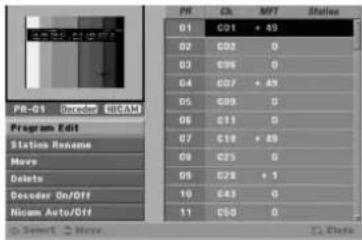
Press ENTER while [Edit] is selected. The Program List menu appears.
text_image
PR-01 Program Edit Station Rename Move Delete Decoder On/Off Nicom Auto/Off PH Ch MT Station 01 C01 + 49 02 C02 0 03 C06 0 04 C07 + 49 05 C09 0 06 C11 0 07 C19 + 49 08 C25 0 09 C28 + 1 10 C43 0 11 C50 0-
Use ▲ / ▼ to select a PR number then press ENTER.
-
Use ▲ / ▼ to select the program option then press ENTER.
- [Program Edit] Sets the channel manually. See "Program Edit" on the right.
- [Station Rename] Changes the station name. The display for entering characters appears. To enter characters, see page 43. Names can be up to 5 characters long.
- [Move] Sorts the programme positions on the Program List. Press ▲ / ▼ to move the selected programme position to a new location.
- [Delete] Disables a programme position you do not need.
- [Decoder On/Off] Sets the channels for the decoder. You need this setting to watch or record PAY-TV/Canal Plus programmes. Press ENTER so [Decoder] appears on the display. Press ENTER again to turn off the setting.
- [NICAM Auto/off] Sets the channels for the NICAM broadcast. Normally, [NICAM] is lit on the display. If the sound from NICAM broadcast is not clear, press ENTER so [NICAM] disappears.
- Press RETURN (💡) to exit Program List menu.
Program Edit
You can perform a search to select and store TV channels manually.
When you select [Program Edit] in step 4 above, the display for setting channels appears.
- Use ◀ / ▶ to select the item and press ▲ / ▼ to change the setting.

• [PR] indicates the selected programme position.
- [Seek] Searches for a channel automatically. Searching stops when the recorder tunes in a channel.
• [Ch.] Changes the channel number.
- [MFT] Fine tunes the channel to obtain a clearer picture.
- Choose OK then press ENTER to confirm the setting and returns to the Program List menu.
AV1 Decoder
Sets the EURO AV1 AUDIO/VIDEO jack for inputting encoded video signals.
-
Press AV while the Program List menu appears.
-
Press ENTER so [Decoder] appears on the display. Press ENTER again to turn off the setting.
- Off: Inputs the signals from the EURO AV1 AUDIO/VIDEO jack. Normally select this.
- On: The encoded video signal input from the EURO AV1 AUDIO/VIDEO jack is output to the EURO AV2 DECODER jack for decoding. The decoded signal is then input back through the EURO AV2 DECODER jack so you can record or view PAY-TV/Canal Plus programmes.
Clock Set
- Select [Clock set] option then press ▶.
- Press ▶.
- Enter the necessary information for date and time.
◀ / ▶ (left/right): Moves the cursor to the previous or next column.
▲ / ▼ (up/down): Changes the setting at the current cursor position.
- Press ENTER to confirm your setting.
TV Aspect
Selects the aspect ratio of the connected TV (4:3 standard or wide).
- [4:3] Select this when connecting to a 4:3 screen TV. When you select [4:3], set [Display Mode] below.
• [16:9] Select this when connecting to a wide-screen TV or TV with a wide mode function.
Display Mode
Selects how to display a wide picture on the screen when [4:3] is selected in [TV Aspect].
- [Letter Box] Displays a wide picture with bands on the upper and lower portions of the screen.
- [Pan Scan] Automatically displays a wide picture on the entire screen and cuts off the portions that do not fit.
AV2 Connection
You can connect a decoder or other device to the EURO AV2 DECODER socket on the back.
- [Decoder] Select [Decoder] if you connect the recorder's EURO AV2 DECODER jack to a PAY-TV or Canal Plus decoder.
- [Others] Select [Others] if you connect the recorder's EURO AV2 DECODER jack to a VCR or similar recording device.
Progressive Scan
Progressive Scan Video provides the highest quality pictures with less flickering.
If you are using the COMPONENT/PROGRESSIVE SCAN VIDEO OUT jacks, but are connecting the recorder to a standard (analog) television, set Progressive Scan to [OFF].
If you are using the COMPONENT/PROGRESSIVE SCAN VIDEO OUT jacks for connection to a TV or monitor that is compatible with a progressive scan signal, set Progressive Scan to [ON].
Notes:
- Progressive Scan will be disabled in the setup menu when you set Video Output Format to [RGB].
Video Output Format
Select the Video output format option according to the connection type of this unit.
- [YPbPr] When your TV is connected with the COMPONENT OUTPUT jack on this unit.
- [RGB] When your TV is connected with the SCART(RGB signal) jack on this unit.
Power Save Mode
You can set up the unit into an economic power save mode. Nothing is displayed in the display window when the unit is turned off.
• [OFF] Power Save Mode is not active.
• [ON] Power Save Mode is active.
Notes:
- You should set the clock to operate an economic power save.
- The encoded television signals (CANAL+ or PREMIERE) are not decoded in the Power Save Mode.
- The Power Save Mode is not available in the standby mode for the timer recording and when power off of the unit after receiving the encoded television signals (CANAL+ or PREMIERE).
Initialization
[Factory Set] If you need to, you can reset the recorder to all its factory settings. Some options cannot be reset. (Rating, Password, and Area Code)
- Select [Initialization] option then press ▶.
- Press ▲ / ▼ to select the desired option then press ENTER. The confirm message will appear.
- Use ◀/▶ to select [Ok] or [Cancel] then press ENTER.
Language Settings

text_image
Display Menu English Deutsch Potski Meyer Český Pyceskýil Language Place Move Order CloseDisplay Menu
Select a language for the Setup menu and on-screen display.
Disc Menu/Audio/Subtitle
- [Original]Refers to the original language in which the disc was recorded.
- [Others] To select another language, press number buttons then ENTER to enter the corresponding 4-digit number according to the language code list in the reference chapter (see page 47). If you enter the wrong language code, press ◀.
• OFF : Turn off Subtitle.
Audio Settings

text_image
Bally Digital DTS MPEG Sampling freq. DBC Vocat PCM ✓ Bitstream Audio Press Move CloseDolby Digital / DTS / MPEG
- [Bitstream]: Select "Bitstream" if you connect the recorder's DIGITAL AUDIO OUT jack to an amplifier or other equipment with a Dolby Digital, DTS or MPEG decoder.
- [PCM] (for Dolby Digital / MPEG): Select when connected to a two-channel digital stereo amplifier. DVDs encoded in Dolby Digital or MPEG will be automatically downmixed to two-channel PCM audio.
- [Off] (for DTS): If you select "Off", the DTS signal is not output through the DIGITAL AUDIO OUT jack.
Sampling Frequency
If your receiver or amplifier is NOT capable of handling 96 kHz signals, select [48 kHz]. When this choice is made, this unit will automatically convert any 96 kHz signals to 48 kHz so your system can decode them.
If your receiver or amplifier is capable of handling 96 kHz signals, select [96 kHz]. When this choice is made, this unit will pass each type of signal through without any further processing.
DRC (Dynamic Range Control)
With the DVD format, you can hear a program's soundtrack in the most accurate and realistic presentation possible, thanks to digital audio technology. However, you may wish to compress the dynamic range of the audio output (the difference between the loudest sounds and the quietest ones). Then, you may listen to a movie at a lower volume without losing clarity of sound. Set DRC to [ON] for this effect.
Vocal
Set Vocal to [ON] only when a multi-channel karaoke DVD is playing. The karaoke channels on the disc will mix into normal stereo sound.
Lock (Parental Control) Settings
text_image
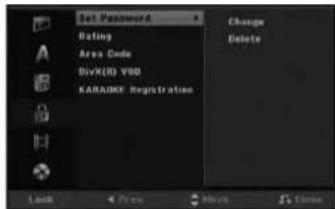
Set Password Rating Area Code DivX(R) VDD KARADKE Registration Change Delete Lock Press Move CloseSet Password
- Select [Set Password] option then press ▶.
- To access the Rating, Password and Area Code features, you must input the 4-digit security code you created.
If you have not yet entered a security code you are prompted to do so. Input a 4-digit code and press ENTER. Enter it again and press ENTER to verify. If you make a mistake before pressing ENTER, press ◀.
To change the password, select the [Change], press ENTER and input the old 4-digit code. And input the new 4-digit code then press ENTER Input it again to verify.
To delete the password, select [Delete] then press ENTER.
If you forget your 4-digit code
If you forget your password, to clear the current password, follow the procedure below.
- Display Setup menu then select an 1 level icon.
- Use the Number buttons to enter the 6-digit number "210499".
- Select [Yes] then press ENTER. The 4-digit password is cleared. Enter a new code.
Rating
Blocks playback of rated DVDs based on their content. Not all discs are rated.
- Select [Rating] option then press ▶.
- Follow step 2 as shown "Set Password".
- Select a rating using the ▲ / ▼ buttons.
[1] - [8]: Rating one (1) has the most restrictions and rating eight (8) is the least restrictive.
[No Limit]: If you select [No Limit], parental control is not active and the disc plays in full.
- Press ENTER to confirm your rating selection.
Note:
If you set a rating for the recorder, all disc scenes with the same rating or lower are played. Higher rated scenes are not played unless an alternate scene is available on the disc. The alternative must have the same rating or a lower one. If no suitable alternative is found, playback stops. You must enter the 4-digit password or change the rating level in order to play the disc.
Area Code
Enter the code of an area whose standards were used to rate the DVD video disc, referring to the list (See "Area Codes", page 47.).
- Select [Area Code] option then press ▶.
- Follow step 2 as shown "Set Password".
- Select the first character using the ▲ / ▼ buttons.
- Shift the cursor using ▶ buttons and select the second character using ▲ / ▼ buttons.
- Press ENTER to confirm your area code selection.
DivX(R) VOD
We provide you the DivX® VOD (Video On Demand) registration code that allows you to rent and purchase videos using the DivX® VOD service. For more information, visit www.divx.com/vod.
- Select [DivX(R) VOD] option then press ▶.
- Press ENTER and the registration code will appear.
- Use the registration code to purchase or rent the videos from Divx® VOD service at www.divx.com/vod. Follow the instructions and download the video onto a disc for playback on this unit.
Note:
All the downloaded videos from DivX® VOD can only be played back on this unit.
KARAOKE Registration
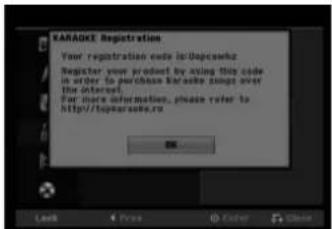
You can check the 8byte Karaoke Registration Code to download karaoke music files on the website(topkaraoke.ru).
- Select [Karaoke Registration] then press ▶.
- Press ENTER and you can find the Karaoke Registration Code on the popup window.
text_image
KARADKE Registration Your registration code is:logp######## Register your product by using this code in order to purchase Karadke zings over the Internet. For more information, please refer to http://logp########.ru OK...- Access the website (http://topkaraoke.ru) and select a song you want.
- Enter the 8byte Registration Code you previously found on the Karaoke Registration menu as the HOMEPAGE Registration code.
- Download the selected song file to PC/USB.
Tip:
You can burn the downloaded karaoke files into CD discs(CD-R/CD-RW) to use in internet karaoke mode.
Recording Settings
text_image
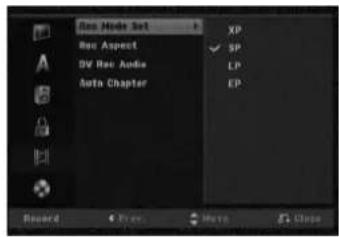
Rev Mode Set Rev Aspect DV Rev Audio Auto Chapter XP ✓ SP LP EP Record Ever Movie CloseRecord Mode Set
You can set the picture quality for recording; XP (High Quality), SP (Standard Quality), LP (Low Quality), EP (Extend Quality).
Record Aspect
When DVD recording, you can set the recording aspect ratio to suit the material you're recording (16:9 or 4:3).
Note:
You can only set VR mode formatted DVD-RW disc.
DV Recording Audio
You need to set this if you have a camcorder using 32kHz/12-bit sound connected to the front panel DV IN jack.
Some digital camcorders have two stereo tracks for audio. One is recorded at the time of shooting; the other is for overdubbing after shooting.
On the Audio 1 setting, the sound that was recorded while shooting is used.
On the Audio 2 setting, the overdubbed sound is used.
Auto Chapter
When recording in Video mode, chapter markers are put in specified setting. You can change this interval to 5 minutes, 10 minutes or 15 minutes. If you select [None], switch off automatic chapter marking altogether with the [None] setting.
Disc Settings
Disc Format
If you load a completely blank disc, the recorder will initialize the disc.
DVD-R: The recorder initialize the disc to Video mode. The recording mode will always be Video mode.
DVD-RW/DVD+RW/DVD+R(DL)/DVD-RAM: The Initialize menu will appear. Select [Ok] then press ENTER.
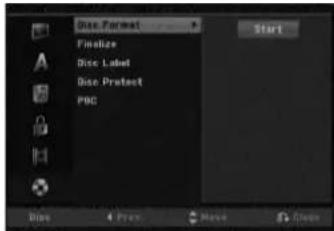
Also, you can reformat the DVD-RW/DVD+RW/DVD-RAM from the Setup menu as below.
text_image
Disk Format Finetize Disc Label Disc Protect PBC Start Disk 4 Press Remove Close- Select [Disc Format] option then press ▶.
- Press ENTER while [Start] is selected. Format Disc menu appears.
- Use ◀ / ▶ to select a desired mode (VR Mode or Video Mode) then press ENTER. (Only DVD-RW) Confirm message will appear. For DVD+RWs, go to step 4.
- Use ◀/▶ to select [Ok] then press ENTER. It takes a few moments to initialize the disc.
Caution
If you want to change the disc format, everything recorded on the disc will be erased.
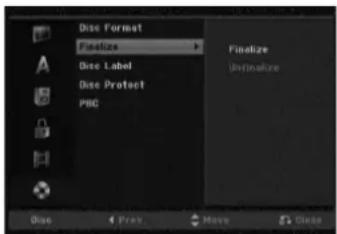
Finalize
Finalizing 'fixes' the recordings in place so that the disc can be played on a regular DVD player or computer equipped with a suitable DVD-ROM drive. Finalizing a Video mode disc creates a menu screen for navigating the disc. This is accessed by pressing MENU/LIST or TITLE.

Caution
- Once you have finalized a DVD-R and DVD+R disc, you cannot edit or record anything else on that disc.
- You can edit or record on the DVD+RW disc even after finalizing.
text_image
Disc Format Finalize Dise Label Dise Protect PBC Finalize Unfinalize Disc Prev Move Close- Select [Finalize] option then press ▶.
- Press ENTER while [Finalize] is selected. Finalize menu appears.
- Select [Ok] then press ENTER. The recorder starts finalizing the disc.
Notes:
- How long finalization takes depends on the type of disc, how much is recorded on the disc, and the number of titles on the disc.
- DVD+R DL disc can take up to 30 minutes to finalize.
Tips
- If you load a DVD-RW that has already been finalized, you can unfinalize it by choosing 'Unfinalize' from the Finalize menu. After doing this, you can edit and re-record onto the disc.
- You cannot unfinalize a DVD-R, DVD+R, and DVD+RW disc.
- If [Disc Protect] option is set to [ON], the finalize is not available. To finalize, set [Disc Protect] option to [OFF].
Disc Label
Use this to enter a name for the disc. This name appears when you load the disc and when you display disc information on-screen.
- For discs formatted on a different recorder, you will see only a limited character set.
- Select [Disc Label] option then press ▶.
- Press ENTER while [Edit] is selected.
Keyboard menu appears.
To enter characters, see page 43.
Disc Protect
When recording in DVD-RAM / DVD+RW / +R disc or VR mode formatted DVD-RW disc, set to [ON] to prevent accidental recording, editing or deleting of the disc loaded. If you need to unlock the disc to make edits, select [OFF].
PBC
PBC stands for Playback Control and refers to special menus and navigation features that are available on some Video CDs.
- [ON] Video CDs are played according to the PBC, if available.
• [OFF] Video CDs are played the same way as Audio CDs.
General Explanation of On-Screen Display
This manual gives basic instructions for operating the recorder. Some DVDs require specific operation or allow only limited operation during playback. When this occurs, the symbol appears on the TV screen, indicating that the operation is not permitted by the recorder or is not available on the disc.
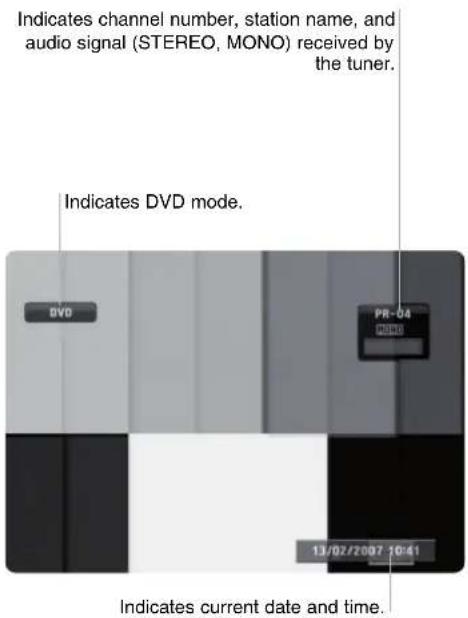
Displaying Information While Watching TV During viewing the TV, press ENTER or DISPLAY to display/remove the Information displayed on-screen.
text_image
Indicates channel number, station name, and audio signal (STEREO, MONO) received by the tuner. Indicates DVD mode. DVD PR-04 13/02/2007 10:41 Indicates current date and time.Displaying Disc Information on-screen
You can display various information about the disc loaded on-screen.
- Press DISPLAY to show various playback information. The items displayed differ depending on the disc type or playing status.

text_image
DVD 1/17+ 1/21 00:00:11 1 ENG 3D0 5.1 CH 1 KOR 1/1 Normal NEW LINE CINEMA Title Move 0.8 input Enter- You can select an item by pressing ▲ / ▼ and change or select the setting by pressing ◀ / ▶. For details about each item, see the pages in parentheses.
• [Title]: Current title (or track) number/total number of titles (or tracks)
• [Chapter]: Current chapter number/total number of chapters
• [Time]: Elapsed playing time (page 26)
• [Audio]: Selected audio language (DVD VIDEO only) or audio channel (page 25)
• [Subtitle]: Selected subtitle (page 25)
• [Angle]: Selected angle/total number of angles (page 26)
• [Sound]: Selected sound mode (page 27)
Note:
If no button is pressed for 10 seconds, the on-screen display disappears.
Playback
General Playback Features
- Load your chosen disc in the tray, with the playback side down.
- Starts playback using HOME menu (see page 15).
- To stop the playback, press STOP (■).
The unit records the stopped point, depending on the disc. "■" appears on the screen briefly.
Press PLAY (▶) to resume playback (from the scene point). If you press STOP (■) again or unload the disc
("■" appears on the screen.), the unit will clear the stopped point.
- Press OPEN/CLOSE (▲) to remove the disc.
Press OPEN/CLOSE (▲) to close disc tray or press POWER (○), the disc tray closes automatically and unit
turns off.
Note:
If Parental Control is set and the disc is not within the Rating settings (not authorized), the 4-digit code must be entered and/or the disc must be authorized (see "Rating", on page 19).
| Buttons Operations | Discs | |
| OPEN / CLOSE (▲) | Opens or closes the disc tray. | All Discs |
| PAUSE/STEP (■) | During playback, press PAUSE/STEP (■) to pause playback. | All Discs |
| Press PAUSE/STEP (■) repeatedly to play Frame-by-Frame. | VCDI DiAKI | |
| ◀◀ / ▶▶▶ (SKIP) | During playback, press ◀◀◀ or ▶▶▶ to go to the next chapter/track or to return to the beginning of the current chapter/track.Press ◀◀◀ twice briefly to step back to the previous chapter/track.Tips:To go directly to any chapter during DVD playback, press DISPLAY and press ▲ / ▼ to select the chapter icon.Then, input the chapter number or use ◀◀ / ▶.On an Audio CD, to go directly to any track, enter the track number using the numbered buttons (0-9) during playback. | DivX\STMA |
| ◀◀ / ▶▶ (SCAN) | During playback, press ◀◀◀ or ▶▶ repeatedly to select the required scan speed.DVD, DivX ; 4 stepsVideo CD, Audio CD; 3 steps | ACD |
| While the playback is paused, press ◀◀◀ or ▶▶ repeatedly to play in slow motion.DVD; 4 stepsDivX; 4 steps (Forward only)Video CD; 3 steps (Forward only) | DivX\VCDI | |
| ZOOM During playback or pause mode, press ZOOM to enlarge the video image.(x1 size → x2 size → x4 size → x1 size (normal size)You can move through the zoomed picture using ◀◀ ▶ ▷ buttons. | ||
| REPEAT During playback, press REPEAT repeatedly to select a desired repeat mode.DVD, VR mode DVD-RW (Title/Chapter/Off)Video CD (Title/ALL/Off)Audio CD, MP3/WMA (TRACK/ALL/(OFF))Notes:On a Video CD with PBC, you must set PBC to [OFF] in the Setup menu to use the Repeat function. See page 22.If you press ▶▶I once during Repeat Chapter (Track) playback, the repeat playback cancels. | ||
| A-B During playback, each press of the A-B button to select point A and point B and repeats a sequence from point A (Starting point) to point B (End point). | ||
| TITLE If the current DVD title has a menu, the title menu appears on the screen. Otherwise, the disc menu may appears. | DVD | |
| MENU/LIST The disc menu appears on the screen. | DVD | |
| SUBTITLE (☐)During playback, press SUBTITLE (☐) then press ◀ / ▶ repeatedly to select a desired subtitle language. | DVD DivX | |
| AUDIO (○○)Press AUDIO (○○) then press ◀ / ▶ repeatedly to hear a different audio language or audio track.Note:Some discs feature both Dolby Digital and DTS soundtracks. There is no analog audio output when DTS is selected. To listen to the DTS soundtrack, connect this recorder to a DTS decoder via one of the digital outputs. See page 12 for connection details. | DVD | |
| Press AUDIO (○○) then press ◀ / ▶ repeatedly during playback to hear a different audio channel (STEREO, LEFT or RIGHT).With DVD-RW discs recorded in VR mode that have both a main and a Bilingual audio channel, you can switch among Main (L), Sub (R), or Main+sub (L+R). | -RWvr -RWVideo RAM+RW -R +RVCD DivX | |
| INSTANT SKIP Press INSTANT SKIP repeatedly during playback to skip forward 15 seconds. | ||
If a menu screen is displayed

VCDD
The menu screen may be displayed first after loading a DVD or Video CD which contains a menu.
DVD
Use the ◀/▶/▲/▼ buttons to select the title/chapter you want to view, then press ENTER to start playback. Press TITLE or MENU/LIST to return to the menu screen.
VCD
- Use the number buttons to select the track you want to view. Press RETURN (💡) to return to the menu screen.
- Menu setting and the exact operating procedures for using the menu may differ depending on the disc. Follow the instructions on the each menu screen. You may also set PBC to [OFF] under Setup menu (see page 22).
Moving to another TITLE
-RWVR
-RWvideo


VCDE
When a disc has more than one title, you can move to another title as follows:
- Press DISPLAY during playback then use ▲ / ▼ to select the title icon. Then, press the appropriate numbered button (0-9) or ◀ / ▶ to select a title number.
Note:
On a Video CD with PBC, you must set PBC to OFF in the Setup menu. See page 22.
Time Search
-RWVR
m = 311
Video
m = 311
+RWF


VCDI
To start playing at any chosen time on the disc:
- Press DISPLAY during playback. The time search box shows the elapsed playing time.
- Press ▲ / ▼ to select the time clock icon and “--:--:--” appears.
- Input the required start time in hours, minutes, and seconds from left to right.
- Press ENTER to confirm. Playback starts from the selected time.
Note:
On a Video CD with PBC, you must set PBC to OFF in the Setup menu. See page 22.
Marker Search
-RWVR
m = 311
Video
RAM-


V
CDD
To enter a Marker
You can start playback from up to nine memorized points. To enter a marker, press MARKER at the desired point on the disc. The Marker icon appears on the TV screen briefly. Repeat to enter up to nine markers.
To Recall or Clear a Marked Scene
- During disc playback, press SEARCH. The marker search menu appears on the screen.
- Within 5 seconds, press ◀ / ▶ to select a marker number that you want to recall or clear.
- Press ENTER and playback starts from the marked scene. Or, press CLEAR and the marker number is erased from the list.
Camera Angle DVD
If the disc contains scenes recorded at different camera angles, you can change to a different camera angle during playback.
-
Press DISPLAY during playback. The On-Screen Display appears on the TV screen.
-
Use ▲ / ▼ to select the Angle icon in the On-Screen Display.
-
Use ◀/▶ to select a desired angle. The number of the current angle appears on the TV screen.
3D Surround
-RWVR
Video

+RWP
This unit can produce a 3D Surround effect, which simulates multi-channel audio playback from two conventional stereo speakers, instead of the five or more speakers normally required to listen to multi-channel audio from a home theater system.
- Press DISPLAY during playback. The On-Screen Display appears on the TV screen.
- Use ▲ / ▼ to select the Sound icon in the On-Screen Display.
- Use ◀ / ▶ to select "3D Sur". To turn off the 3D Surround effect, select "Normal".
Last Condition Memory

DVD
This recorder memorizes the user settings for the last disc that you have viewed. Settings remain in memory even if you remove the disc from the recorder or switch off the recorder. If you load a disc that had its settings memorized, the latest stop position is automatically recalled.
Notes:
- Settings are stored in memory for use any time.
- This recorder does not memorize settings of a disc if you switch off the recorder before commencing to play it.
PIP (Picture in Picture)
-RWVR
-RWvideo
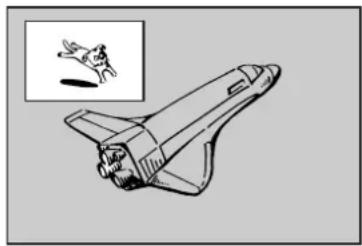
This function enables you to view the stored stations in sub picture during playback.
natural_image
Line drawing of a space shuttle with an inset showing a cartoon character (no text or symbols)On and off
Press PIP to switch on the sub picture, press this button again to switch it off.
Input mode selection for sub picture
Press AV to select the input mode for the sub picture. Each time this button is pressed, each input mode for the sub picture is displayed as shown below.
$$ \text { Tuner } \rightarrow \text { AV1 } \rightarrow \text { AV2 } \rightarrow \text { AV3 } $$
Program selection for sub picture
Use ▲ / ▼ to change the program when sub picture's input is set to tuner. The selected program number is displayed on the TV screen. You can view the selected program by pressing STOP (■).
Sub picture position change
Press ◀ / ▶ repeatedly until desired position is achieved. The sub picture moves clockwise or counterclockwise.
Playing a DivX Movie File
The recorder can play Divx files. Before playing DivX files, read "DivX file requirement" on the right.
-
Press HOME then select [MOVIE] option.
-
Select a media that contains DivX file(s) then press ENTER.
The [Movie List] menu appears on the TV screen.

text_image
Movie List FOLDEN 31 FOLDEN 32 FOLDEN 33 File 32.mtl File 32.mtl Color 50% Marks Fade- Press ▲ / ▼ to select a folder, and press ENTER. A list of files in the folder appears. If you are in a file list and want to return to the Folder list, use the ▲ / ▼ buttons on the remote to highlight 🔒 and press ENTER.
- If you want to view a particular file, press ▲ / ▼ to highlight a file and press PLAY (▶). You can use variable playback functions. Refer to pages 24-27.
- Press STOP to stop the playback. The [Movie List] menu appears.
Notice for displaying the DivX subtitle
If the subtitle does not display properly, please follow the steps below.
- Press PAUSE/STEP when the subtitle appears.
- Press and hold SUBTITLE about 5 seconds. The language code will appear.
- Press SUBTITLE to select another language code until the subtitle is displayed properly.
- Press PLAY (▶) to continue playback.
Movie List menu options
- Press ▲ / ▼ to select a folder/file on the [Movie List] menu then press ENTER. [Movie List] menu options appear. The menu options displayed differ depending on the selected media.
- Press ▲ / ▼ / ◀ / ▶ to select an option, and press ENTER.
• [Play] Start playback the selected title.
• [Open] Opens the folder and a list of files.
DivX file requirement
Available resolution size: 720x576 (W x H) pixel DivX file extensions: ".avi", ".divx"
playable DivX subtitle: ".smi", ".srt", ".ssa",
".sub (Micro DVD format)",
".txt (Micro DVD format)"
Playable Codec format: "DIV3", "DIVX", "DX40", "DX50", "3ivx", "MP4V2", "MP4V3"
playable Audio format: "AC3", "PCM", "MP3", "DTS"
• Sampling frequency: within 32 - 48 kHz (MP3)
- Bit rate: within 32 - 320kbps (MP3)
CD-R Format: ISO 9660 and JOLIET.
DVD±R/RW Format: ISO 9660 (UDF Bridge format)
Maximum Files/Disc: Less than 999 (total number of files and sub folders in one folder)
*As you store more files in one folder, the operation like opening the folder may be slower.
Notes on DivX format
- If the number of the screen frame is over 29.97 frames per second, this unit may not operate normally.
- If the video and audio structure of recorded file is not interleaved, returns to the menu screen.
Playing an Audio CD or MP3/WMA file
The recorder can play audio CDs and MP3/WMA files. Before playing MP3/WMA files, read "MP3/WMA audio file requirement" on the right.
- Press HOME.
The HOME menu appears.
-
Select [MUSIC] option.
-
Select a media that contains MP3/WMA or audio title then press ENTER.
The [Music List] menu appears on the TV screen.
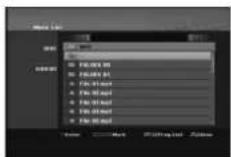
- Use ▲/▼ to select a track then press PLAY (▶). Playback starts.
You can use variable playback functions. Refer to pages 24-27.
Tips:
- Press DISPLAY to view ID3-Tag information for the MP3 file. If ID3-Tag information is not present, [ID3-Tag: None] will appear. Press DISPLAY again to remove the information screen.
- If you want to move to the upper directory, use the ▲ / ▼ to highlight 🔒 and press ENTER.
- To stop playback at any time, press STOP.
Audio CD and Music menu options
-
Press ▲ / ▼ to select a folder/file on the Audio CD or Music menu then press ENTER. The menu options appear. The menu options displayed differ depending on the selected media.
-
Press ▲ / ▼ / ◀ / ▶ to select an option, and press ENTER.
• [Play] Start playback the selected title.
• [Random] Start or stop random playback.
- [Open] Opens the folder and a list of files in the folder appears
- [Prog. add] Adds the track(s) to Program List. (page 30)
Random
-
Press ▲ / ▼ to select a file then press ENTER. The menu options appear.
-
Press ▲ / ▼ to select [Random] option then press ENTER.
The unit automatically begins random playback and "RANDOM" appears on the menu screen.
- To return to normal playback, select [Random] option again then press ENTER.
Tip:
By pressing ▶▶ during Random playback, the unit selects another track and resumes Random playback.
MP3/WMA audio file requirement
File extensions
".mp3", ".wma".
Sampling frequency:
within 32 - 48 kHz (MP3) / V2, V4, V7, V8 (WMA)
Bit rate:
within 32 - 320kbps (MP3), 5 - 192kbps (WMA)
CD-R Format:
ISO 9660 and JOLIET.
DVD±R/RW Format:
ISO 9660 (UDF Bridge format)
Maximum Files/Disc:
Less than 999 (total number of files and sub folders in one folder)
*As you store more files in one folder, the operation like opening the folder may be slower.
Program Playback with Audio CD and MP3/WMA file
Program Playback enables you to make custom playlists of Audio CD or MP3/WMA tracks. Programs can contain up to 99 Audio CD tracks or 256 MP3/WMA files.
- Use ▲ / ▼ to select a track/file (or folder) on the Audio CD or Music menu.
Selecting multiple files/tracks (folders)
- Press MARKER.
A check mark appears on the file/track or folder. Press MARKER again to cancel the marked file/track or folder.
-
Repeat step 1 to mark additional file/track (folders).
-
Press ENTER.
The options appear on the left side of the menu.
-
Use ▲ / ▼ to select the [Prog. add] option then press ENTER.
-
Repeat steps 1-3 to mark additional tracks.
Note:
If you select a folder for Programmed Playback, all tracks/files in the folder are added to the Program List.
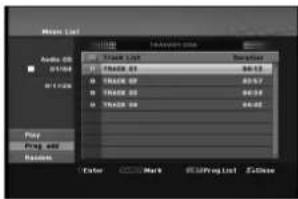
text_image
Music List Audio 03 ■ Audio B:128 Play Play key Balance Track List Track 01 Track 02 Track 03 Track 04 Selection line Selection 04-12 05-17 06-24 06-28 06-33 06-38 06-43 OK/OK/OK/OK/OK/OK/OK/OK/OK/OK/OK/OK/OK/OK/OK/OK/OK/OK/OK/OK/OK/OK/OK/OK/OK/OK/OK/OK/OK/OK/OK/OK/OK/OK/OK/OK/OK/OK/OK/OK/OK/OK/OK/OK/OK/OK/OK/OK/OK/OK/OK- Use ▶ to move to the Program list.
The programmed track you selected last is highlighted on the program list.
-
Use ▲ / ▼ to select the track you want to start playing.
-
Press PLAY (▶) to start.
Playback stops after playing the last programmed track in the program list.
- To exit Program Playback and resume normal playback, select a track on the List and press PLAY (▶).
Tip:
- You can access or remove the Program List screen by pressing MENU/LIST.
Program List menu options
- Press ▲ / ▼ to select a track/file on the Program List then press ENTER. The menu options appear.

- Use ▲ / ▼ to select an option then press ENTER to confirm your selection.
• [Play] Playback begins in the order in which you programmed the tracks from the selected track.
• [Random] Start or stop random playback.
- [Delete] Deletes the track(s) from the Program List menu.
Repeat Programmed Tracks
Press REPEAT to select the desired Repeat mode.
• [TRACK] Repeats the current track.
• [ALL] Repeats all tracks on the Program List.
• [OFF] Cancels Repeat mode (no display).
Erasing a Track from the Program List
-
Select the track you wish to erase from the Program List. Use MARKER button to select multiple tracks.
-
Press ENTER. The menu options appears
-
Select [Delete] option then press ENTER.
Viewing a JPEG File
The recorder can play JPEG files. Before playing JPEG recordings, read "Photo file requirement" on right.
- Press HOME.
The HOME menu appears.
-
Select [PHOTO] option.
-
Select a media that contains JPEG file then press ENTER.
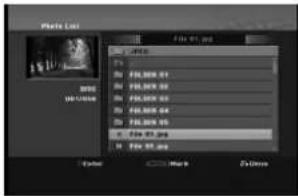
The [Photo List] menu appears on the TV screen.
text_image
Photo List File 01.jpg 文件(F) File 02.jpg File 03.jpg File 04.jpg File 05.jpg File 06.jpg File 07.jpg File 08.jpg Outlook Music Go/Show- Use ▲ / ▼ to select a file, then press ENTER. The menu options appear on the left side of the menu.
Tips:
- If you want to move to the upper directory, use the ▲ / ▼ to highlight 🔒 and press ENTER.
-
You can also display HOME menu to select another media by pressing HOME.
-
Use ▲ / ▼ to select [Full Screen] then press ENTER.
The selected image is displayed in full screen. Depending upon the size and number of JPEG files, it could take a long time for the recorder to read the files.
natural_image
Black-and-white landscape photo showing trees and a distant horizon under cloudy sky (no text or symbols)Press ENTER to appear or disappear this menu during viewing the full screen.
- To stop viewing at any time, press STOP. The [Photo List] menu appears.
Photo List menu options
- Press ▲ / ▼ to select a file on the [Photo List] menu then press ENTER. The menu options appear. The menu options displayed differ depending on the selected media.
Selecting multiple files (folders)
-
Press MARKER. A check mark appears on the file or folder. Press MARKER again to cancel the marked file or folder.
-
Repeat step 1 to mark additional file (folders).
-
Use ▲ / ▼ to select an option then press ENTER to confirm your selection.
-
[Open] Opens the folder and a list of files in the folder appears
- [Full Screen] Shows the selected file as full screen.
• [Slide Show] Displays Slide Show menu.
Photo file requirement
File extensions
".jpg"
Photo size:
Less than 4MB recommended
CD-R Format:
ISO 9660 and JOLIET.
DVD±R/RW Format:
ISO 9660 (UDF Bridge format)
Maximum Files/Disc:
Less than 999 (total number of files and sub folders in one folder)
*As you store more files in one folder, the operation like opening the folder may be slower.
Notes on JPEG file
Progressive and lossless compression JPEG image files are not supported.
Skip Images
While viewing a picture, press ◀◀◀ or ▶▶▶ once to advance to the next file or return to the previous file.
Rotate Images
Use ▲ / ▼ while viewing a picture to flip the picture clockwise or counterclockwise.
View Slide Shows
-
Select [Slide Show] option on the [Photo List] menu (Refer to "Photo List menu options" on page 31).
-
Press ENTER. The Slide Show menu appears.

text_image
Slide Show Object All Speed Normal Start Cancel- Use ◀ / ▶ / ▲ / ▼ to set the options.
[Object] option:
- [Selected] Views slide show only selected files. Use the MARKER button to select multiple files
• [All] Views slide show all files.
[Speed] option: Sets the Slide Show speed to [Slow], [Normal], or [Fast].
-
Select the [Start] option then press ENTER to start the Slide Show.
-
Press STOP to stop the Slide Show and returns to the [Photo List] menu.
To Pause the Slide Show
-
Press PAUSE/STEP (III) to pause slide show.
-
When you want to continue slide show, press PAUSE (III) or PLAY (▶).
Recording
About DVD recording
Notes:
- This recorder cannot make recordings on CD-R or CD-RW discs.
- Our company takes no responsibility for recording failure due to power outages, defective discs, or damage to the Recorder.
- Fingerprints and small scratches on a disc can affect playback and/or recording performance. Please take proper care of your discs.
Disc types and recording formats, modes, and settings
This recorder can play various kinds of DVD discs: pre-recorded DVD-Video discs, DVD-RW, DVD-R, DVD-RAM, DVD+RW and DVD+R discs. The disc format for DVD-R, DVD+R, DVD+RW discs is always "Video format"—the same as pre-recorded DVD-Video discs. This means that once finalized, you can play a DVD-R, DVD+R, or DVD+RW in a regular DVD player. The DVD-RAM disc format is Video Recording (VR) format.
The recording mode is closely related to the disc format. If the disc format is Video Recording format, then the recording mode is VR mode; if the disc format is Video mode, then the recording mode is Video mode (except for DVD-Video, which is not recordable, and so does not have a recording mode). Within the recording modes (which are fixed for them whole disc) are the record settings. These can be changed as required for each recording and determine the picture quality and how much space the recording will take up on the disc.
Notes for recording
- The recording times shown are not exact because the recorder uses variable bit-rate video compression. This means that the exact recording time will depend on the material being recorded.
- When recording a TV broadcast, if the reception is poor or the picture contains interference, the recording times may be shorter.
- If you record still pictures or audio only, the recording time may be longer.
- The displayed times for recording and time remaining may not always add up to exactly the length of the disc.
- The recording time available may decrease if you heavily edit a disc.
- If using a DVD-RW disc, make sure you change the recording format (Video mode or VR mode) before you record anything on the disc. See page 21 (Disc Format) for how to do this.
- When using a DVD-R or DVD+R disc, you can keep recording until the disc is full, or until you finalize the disc. Before you start a recording session, check the amount of recording time left on the disc.
- When using a DVD+RW disc, recording time available will only increase if you erase the last title recorded on the disc.
- The Delete Title option in the Title List (Original) menu only hides the title, it does not actually erase the title from the disc and increase the recording time available (except for the last recorded title on a DVD-RW disc in Video mode).
- Overwrite recording is available using DVD+RW discs.
- When using a DVD+R/RW, the recorder will execute the Menu-making operation to update the new title and editing when removing the disc from the recorder.
Recording time and picture quality
There are four preset recording quality modes:
- XP – Highest quality setting, gives about 1 hour of recording time on a DVD (4.7GB).
- SP – Default quality, sufficient for most applications, gives about 2 hours of recording time on a DVD (4.7GB).
- LP – Slightly lower video quality, gives about 4 hour of recording time on a DVD disc (4.7GB).
- EP – Lowest video quality, gives about 6 hour of recording time on a DVD (4.7GB).
You may see a fragmented picture during playing back the contents recorded in EP mode.
Restrications on copying
Some video material is copy-once protected: Such material cannot be copied to DVD. You can identify copy-once protected material during playback by displaying disc information on-screen.
- NTSC format signals from the analog or the DV inputs is not recorded correctly with this recorder.
- Video signals in SECAM format (from the built-in TV tuner or from the analog inputs) are recorded in PAL format.
What is 'CPRM'?
CPRM is a copy protection system (with scramble system) only allowing the recording of 'copy once' broadcast programs. CPRM stands for Content Protection for Recordable Media. CPRM recordings can only be made on DVD-RW discs formatted in VR mode or DVD-RAM discs, and CPRM recordings can only be played on players that are specifically compatible with CPRM.
Copyright
- Recording equipment should be used only for lawful copying and you are advised to check carefully what is lawful copying in the area in which you are making a copy. Copying of copyright material such as films or music is unlawful unless permitted by a legal exception or consented to by the rights owner.
- This product incorporates copyright protection technology that is protected by method claims of certain U.S. patents and other intellectual property rights owned by Macrovision Corporation and other rights owners. Use of this copyright protection technology must be authorized by Macrovision Corporation, and is intended for home and other limited viewing uses only, unless otherwise authorized by Macrovision corporation. Reverse engineering or disassembly is prohibited.
- CONSUMERS SHOULD NOTE THAT NOT ALL HIGH DEFINITION TELEVISION SETS ARE FULLY COMPATIBLE WITH THIS PRODUCT AND MAY CUSE ARTIFACTS TO BE DISPLAYED IN THE PICTURE. IN CASE OF 625 PROGRESSIVE SCAN PICUTRE PROBLEMS, IT IS RECOMMENDED THAT THE USER SWITCH THE CONNECTION TO THE 'STANDARD DEFINITION' OUTPUT. IF THERE ARE QUESTIONS REGARDING OUR TV SET COMPATIBILITY WITH THIS MODEL 625p DVD RECORDER, PLEASE CONTACT OUT CUSTOMER SERVICE CENTER.
Basic Recording from a TV
Follow the instructions below to record a TV program. Recording starts immediately and continues until the disc is full or you stop the recording.
Note:
You must load a recordable disc for DVD recording.
- Press HOME.
The HOME menu appears. - Select [TV] option.
- Select [TV DVD] option then press ENTER. Also make sure that the TV input is set to this recorder. If you load a completely blank disc, the recorder takes a short while to initialize the disc.
- Set a recording mode as necessary by pressing REC MODE repeatedly. (XP, SP, LP, EP)
- Use ▲ / ▼ buttons to select the TV channel to record.
Changing TV Audio Channel
You can select the audio channel (language) to listen by pressing AUDIO during viewing TV program. The current audio channel is displayed on-screen.
Stereo broadcast:
Stereo → Left → Right
Bilingual broadcast:
Main → Sub → Main+Sub
- This recorder can record either NICAM or regular audio. If the NICAM setting (page 16) is set to Auto, then if the broadcast is NICAM, the audio automatically changes to NICAM and you can record the NICAM audio. If the broadcast is non-NICAM, the regular audio is always recorded. If NICAM sound distortion occurs, due to poor reception, you can switch off NICAM setting of the program.
- If you record and then play back Mono broadcasting, you can select the audio channel. But in that case, it will not work and the output will operate with Mono.
- Only when you record with Stereo or Main+Sub mode, you can play back with Stereo or Main+Sub.
- Press REC (●) once.
Recording will start. (The REC indicator lights in the display window.)
- Recording continues until you press STOP (■) or the disc is full.
-
To record for a fixed length of time, see Instant Timer Recording on right.
-
Press STOP (■) to stop recording.
To Pause the Recording
- Press PAUSE/STEP (III) to pause recording.
- When you want to continue recording, press PAUSE/STEP (III).
Instant Timer Recording
Instant Timer Recording allows you to make a recording easily of a preset length without using the program timer.
- Follow steps 1-5 as shown left (Basic Recording from a TV).
- Press REC (●) repeatedly to select the recording time length.
Recording starts after the first press. Each subsequent press increases the recording time within free space.
The recording time is displayed on the TV screen. At the end of the recording, the recorder will stop recording and shut off.
Checking the Recording Time
Press REC (●) once to check the recording time. The recalled setting will automatically return to the TV screen for a moment.
Also, remaining time of recording is shown in the display window.
To Extend the Recording Time
The recording time can be extended anytime by pressing REC (●).
Each subsequent press increases the recording time within free space.
Caution
If the recorder is unplugged (or there is a power failure) while the recorder is recording, the recording will be lost.
Timer Recording
This recorder can be programmed to record up to 16 programs within a period of 1 month. For unattended recording, the timer needs to know the channels to be recorded, the starting and ending time.
Note:
If you use a completely blank disc for timer recording, you must format the disc before starting timer recording. (Refer to "Disc Format" on page 21.)
1. Press TIMER REC.
The Timer Record menu will appear.
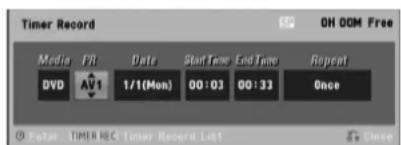
text_image
Timer Record Media PI Date StartTime End Time Repeat DVD AVS 1/1(Mon) 00:03 00:33 Oncetotal TIMER REC Timer Record List Time
- [PR] Choose a memorized program number, or one of the external inputs from which to record. (You cannot select DV input.)
- [Date] Choose a date up to 1 month in advance.
• [Start Time] Set the start time.
• [End Time] Set the end time. -
[Repeat] Choose a desired repeat (Once, Daily (Monday - Friday), or Weekly).
-
Enter the necessary information for your timer recording(s).
-
◀ / ▶ (left/right) – move the cursor left/right
- ▲ / ▼ (up/down) – change the setting at the current cursor position
- Press RETURN (♂) to exit the Timer Record menu.
- Press ENTER after filling in all the program information.
-
Press TIMER REC to display Timer Record List.
-
Set a recording mode as necessary by pressing REC MODE repeatedly. (XP, SP, LP, EP)
-
Press ENTER, the program will be memorized by the recorder.
To check the programming, the Timer Record List will appear.
Check field's "Rec. OK" on the Timer Record List indicates that the timer recording is programmed correctly.
- Press RETURN (♂) to exit the Timer Record List.
- Make sure that you load a recordable disc for DVD recording and press POWER to switch your unit to Standby.
Notes:
- The timer indicator lights in the display window when the recorder is in standby with the timer active. (Nothing is displayed while the [Power Save Mode] is ON.)
- You must press POWER to stop the timer recording.
Checking Timer Recording Details
Programming can be checked whenever the recorder is turned on. Press TIMER REC twice.
- Use ▲ / ▼ to select a timer recording.
- Press ENTER to edit the selected program. Timer Record menu appears.
- Press CLEAR to delete the selected program from the Timer Record List.

text_image
Timer Record List PR Data Start time Duration Mode Check NEW B 28/2(Tue) 08:13 30M SP Rec. OK 10:130 Timer Record Delete Edit CloseCanceling a Timer Recording
You can clear a timer setting anytime before the recording actually starts.
- Use ▲ / ▼ to select a program you want to erase on the Timer Recorder List. If you want to erase the program, press CLEAR.
Stopping a Timer Recording in Progress
After a timer recording has started, you can still cancel the program.
-Press POWER.
Timer Recording Troubleshooting
Even though the timer is set, the recorder will not record when:
• There is not enough space on discs.
• There is no disc loaded.
• A non-recordable disc is loaded.
- [Disc Protect] option is set to [ON] in the Setup menu. (see page 22).
• Power is turned on.
- There are already 99 titles (DVD-RW, DVD-R, DVD-RAM), 49 titles (DVD+R, DVD+RW) recorded on the disc.
You cannot enter a timer program when:
- A recording is already underway.
- The time you're trying to set has already passed.
• There are already 16 timer programs set.
If two or more timer programs overlap:
• The earlier program takes priority.
- When the earlier program finishes, the later program starts.
- If two programs are set to start at exactly the same time, the program entered first takes priority.
If the disc is damaged, the recording may not complete successfully. In this case even though the Check field shows "Rec. OK", it may not be.
Recording from an External Input
Recording from External Components
You can record from an external component, such as a camcorder or VCR, connected to any of the recorder's external inputs.
- Make sure that the component you want to record from is connected properly to the recorder. See page 13-14.
- Choose a media (TV DVD) to record using HOME menu. (see page 15).
- Press AV repeatedly to select the external input to record from.
- Tuner: Built-in tuner
- AV1: EURO AV1 AUDIO/VIDEO mounted on back panel
-
AV2: EURO A/V2 DECODER mounted on back panel
• AV3: AV IN 3 mounted on back panel
• DV: DV IN mounted on front panel -
Select the recording mode as necessary by pressing REC MODE repeatedly. (XP, SP, LP, or EP)
-
Press REC (●) once. Recording will start. (The REC indicator lights in the display window.)
-
Recording continues until you press STOP (■) or the disc is full.
-
To record for a fixed length of time, see "Instant Timer Recording" on page 35.
-
Press STOP (■) to stop recording.
Note:
If your source is copy-protected using CopyGuard, you will not be able to record it using this recorder. See Copyright on page 34 for more details.
Recording from DV Input
Before DV dubbing
You can connect a DV-equipped camcorder to this recorder using a single DV cable for input and output of audio, video, data and control signals.
- This recorder is only compatible with DV-format (DVC-SD, DV25) camcorders. Digital satellite tuners and Digital VHS video recorders are not compatible.
- You cannot connect more than one DV camcorder at a time to this recorder.
- You cannot control this recorder from external equipment connected via the DV IN jack (including two recorders).
- It may not always be possible to control the connected camcorder via the DV IN jack.
- Digital camcorders can usually record audio as stereo 16-bit/48kHz, or twin stereo tracks of 12-bit/32kHz. This recorder can only record one stereo audio track. Set [DV Rec Audio] option to [Audio 1] or [Audio 2] as required (see page 21).
- Audio input to the DV IN jack should be 32 or 48kHz (not 44.1kHz).
- Picture disturbance on the recording may occur if the source component pauses playback or plays an unrecorded section of tape, or if the power fails in the source component, or the DV cable becomes disconnected.
Recording from a Digital Camcorder
You can record from a digital camcorder connected to the DV IN jack on the front panel of this recorder. Using the recorder's remote, you can control both the camcorder and this recorder.
Before recording, make sure that the audio input for the DV IN jack is set up (see page 21).
Tips:
• The source signal must be DVC-SD format.
- Some camcorders cannot be controlled using this recorder's remote.
- If you connect a second recorder using a DV cable, you cannot control the second DVD from this one.
- You cannot control this unit remotely from a component connected to the DV IN jack.
- You cannot record date and time information from a DV cassette.
- Make sure your digital camcorder is connected to the front panel DV IN jack. See page 14.
- Select [TV DVD] option on the HOME menu then press ENTER. (see page 15).
- Check that the DV audio input is as you require. You can choose between Audio 1 (original audio) and Audio 2 (overdubbed audio).
- DV Input is set from the [DV Rec Audio] in sub-menu of the Setup menu. See "DV Recording Audio" on page 21 for more information.
- Press AV repeatedly to select the DV input. DV appears in the display window and on the TV screen.
- Find the place on the camcorder tape that you want to the recording to start from. For best results, pause playback at the point from which you want to record.
- Depending on your camcorder, you can use this recorder's remote to control the camcorder using the STOP, PLAY, PAUSE, FF, and FR functions.
- Press REC (●) once to start recording.
- Recording is automatically stopped if the recorder detects no signal.
- You can pause or stop the recording by pressing PAUSE/STEP (■) or STOP (■). You cannot control the camcorder from this remote control during recording.
- In Video mode, the final frame of the recording may remain displayed on screen for a while after recording stops.
Troubleshooting
If you cannot get a picture and/or audio through the DV IN jack, check the bullet points:
- Make sure the DV cable is properly connected.
- Try switching off the connected equipment then switch back on.
- Try switching the audio input.
Note:
Depending on the connected camcorder, you may not be able to control it using the remote control supplied with this recorder.
Editing
Title List and Chapter List Menu Overview
Using the Title List menu you can edit video content. The editing features available in the Title List menu depend on whether you are editing video on DVD and whether you're editing Original content, or a Playlist. There are two ways to edit VR mode DVD-RW discs. You can directly edit the Original content of the disc, or you can create and edit a Playlist. The Playlist doesn't actually change any of the content on the disc, but just controls how the content is played back.
-
Press MENU/LIST to display the Title List menu. Playback should be stopped when you do this.
-
You can also access it using HOME menu, select [MOVIE] option then select [DISC] option and press ENTER.
- When selecting titles, use the ▲ / ▼ buttons to display the previous/next page if there are more than six titles.
- If you are editing a VR mode disc, press MENU/LIST to switch between Original and Playlist menu.
On the left side of the screen are the menu options. The main part of the screen shows thumbnails of the titles (or chapter) on the DVD. You can change these thumbnails using the THUMBNAIL button—see Changing Title Thumbnails on page 40.
Press DISPLAY to display the information of selected title on the Title List menu.
After selecting a title or chapter on the Title List or Chapter List menu, then press ENTER. The menu options appears on the left side of the menu. Use ▲ / ▼ to select a option then press ENTER to confirm your selection.
- To exit the Title List menu, press RETURN (♂) repeatedly.
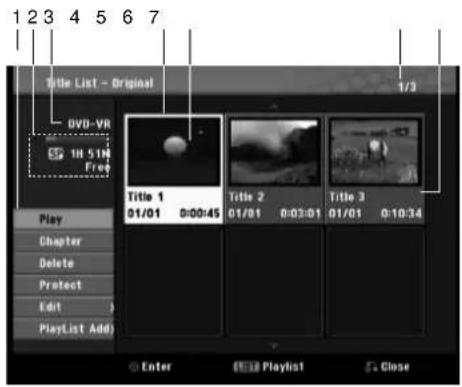
text_image
1 2 3 4 5 6 7 Title List - Original DVD-VR 1H 51M Free Title 1 01/01 0:00:45 Title 2 01/01 0:03:01 Title 3 01/01 0:10:34 Play Chapter Delete Protect Edit > PlayList Add) Enter Playlist Close- Menu options: To display menu option, select a title or chapter then press ENTER. The options displayed differ depending on the disc type.
• [Combine] Combines two chapters into one (page 44).
● [Delete] Deletes the title or chapter. (page 42) - [Delete Part] Deletes a part of the Title (page 42).
• [Divide] Divides a title into two (page 44).
● [Full Play] Starts playback of the selected title including the hidden chapters.
● [Hide (Show)] Hides (or Shows) the selected chapter. (page 45) - [Move] Moves a chapter on the Chapter List-Playlist menu to a position on the menu. (page 45)
- [Play] Start playback of the selected title or chapter. The hidden chapters on the DVD+R/RW cannot be play back.
• [Chapter] Displays Chapter List of the Title. - [Playlist Add] Adds the title or chapter to the Playlist. (page 41)
● [Protect] Protects accidental recording, editing or deleting of the title. (page 45)
• [Title Name] Edits the title name. (page 43)
• [Title] Displays Title List of the chapter. - Indicates the record mode, free space, and elapsed time progress bar.
- Current media
- Currently selected title.
- Thumbnail
- Shows the selected title number and total number of titles.
- Shows the title name, recorded date, and recording length.
VR Mode: Original and Playlist Editing
Titles, Chapters and Parts
Titles in the disc's original content contain one or more chapters. When you insert a disc's title into the Playlist, all the chapters within that title also appear. In other words, chapters in the Playlist behave exactly as chapters on a DVD-Video disc do. Parts are sections of Original or Playlist titles. From the Original and Playlist menu you can add or delete parts. Adding a chapter or title to the Playlist creates a new title made up of a section (ie., chapter) of an Original title. Deleting a part removes part of a title from the Original or Playlist menu.

Caution
- When editing using the Delete, Add and Move functions, the start and end frames may not be exactly as set in the start and end point display.
- During Playlist playback, you may notice a momentary pause between edits. This is not a malfunction.
Is editing a DVD like editing a video tape?
No. When you edit a video tape you need one video deck to play the original tape and another to record the edits. With DVD, you edit by making a 'Playlist' of what to play and when to play it. On playback, the Recorder plays the disc according to the Playlist.
About word 'Original' and 'Playlist'

VR RAM-
Throughout this manual, you will often see the words Original and Playlist to refer to the actual content and the edited version.
- Original: content refers to what's actually recorded on the disc.
- Playlist: content refers to the edited version of the disc — how the Original content is to be played.
Adding Chapter Markers
VR

+R+
You can create chapters within a title by inserting chapter marks at the desired points.
Note:
Chapter markers are inserted at regular intervals automatically. You can change this interval from the Initial Setup menu (see "Auto Chapter" on page 21).
During recording or playing back, at the point you want to start a new chapter, press CHP ADD. A chapter marker icon appears on the TV screen.
Changing Title Thumbnails
-RWVR


+R+
Each title displayed in the Title List menu is represented by a thumbnail picture taken from the start of that title or chapter.
If you prefer, select a different still picture from within a title.
Press THUMBNAIL to make the currently displayed picture the one that appears in the Title List menu. The still picture that you choose appears in both the Original or Playlist menu.
Tip:
You can also change the thumbnail picture of the title on the Chapter List menu. Select a chapter on the Chapter List menu then press THUMBNAIL. The thumbnail picture of the title that includes the chapter is changed.
Making a New Playlist
VR RAM-R
Use this function to add an Original title or chapter to the Playlist. When you do this, the whole title is put into the Playlist (you can delete bits you don't need later — see Deleting an Original or Playlist title/chapter on page 42).
The title appears in the Playlist complete with the chapter markers that appear in the Original. However, if you add more chapter markers to the Original later, these are not automatically copied over into the Playlist title.
You can add up to 999 chapters to one disc. If you only want to add a chapter of a title, use the Adding a title/chapter to the Playlist on this page.
- Choose a title or chapter on the Title List-Original menu or Chapter List-Original menu to put into the Playlist, then press ENTER. The menu options appears on the left side of the menu.
text_image
Audio List - Original 10:00:00 Time 5 06/01 03:00:24 Audio 5 06/01 06:01:32 Audio 5 08:01 03:10:06 Play Blower Blade Project Solid Play not add Color RGB/Project1 Close- Use ▲ / ▼ to select [Playlist Add] option then press ENTER.
text_image
File List - Original File 00:00 Play Chapter Movie Project OK Project Help Zoom 5 Dowd Plot List New Plot List Color GOLD Plot List View 2 R100 R1106- Select [New Playlist] then press ENTER. The new title appears in the updated Playlist. All chapters of the title are added to the Playlist.
text_image
File Edit - Export 0/1 0/2 0/3/07 Enter Export Drigued CloseAdding Additional Title/Chapters to the Playlist VR RAM-
You can add an Original title or chapter to add to a Playlist title even if it is already registered.
- Choose a title or chapter on the Title List-Original menu or Chapter List-Original menu to put into the Playlist, then press ENTER. The menu options appear on the left side of the screen.

text_image
Title 1 Title 2 Title 3 Title 4 File Share Movie Project GAR Project 2000 00:01 00:04 00:03 00:02 00:01 01:06 Color RGB/Playset Show- Use ▲ / ▼ to select [Playlist Add] from menu options then press ENTER.

text_image
Top List - Original 12.000 774 Play Chapter Movie Project Add PlayList 985 Select PlayList New PlayList Color E:\PlayList Show-
Choose a Title List-Playlist that is already registered to insert a title or chapter, then press ENTER.
-
Repeat steps 1-3 to add additional title or chapter on the Playlist. You can view the added chapters on the Chapter List-Playlist menu.
text_image
Title 1.0 - Playable 00/01 00/02 00/03 00/04 00/05 00/06 00/07 00/08 00/09 00/10 00/11 00/12 < 10x1 00/13-Proposed F: Close- Press RETURN (💡) to exit, or MENU/LIST to go back to the Title List-Original menu.
Deleting an Original or Playlist
Title/Chapter VR RAM-F
When you erase a title or chapter from the Playlist menu, you only remove it from the Playlist; the title/chapter remains in the Original menu.
If you choose to delete a title or chapter from the Original (title/chapter) menu, the title or chapter is actually deleted from the disc and the remaining time available for recording increases. Titles/chapters deleted from the Original are also removed from the Playlist.
Note:
It may not be possible to delete chapters that are less than 5 seconds long.
-
Use ◀/▶/▲/▼ to choose a chapter or title you want to delete on the Title List or Chapter List menu then press ENTER. The menu options appears on the left side of the screen.
-
Select [Delete] option from the options on the menu.
Example: Title List-Original (-RWvr
text_image
Movie List - Preview 07 Movie 3 01:00 D4A19 Play Shower Eating Edit Button Original Close- Press ENTER to confirm.
The confirm message for deleting will appear.
- Use ◀/▶ to select [Ok] then press ENTER.
The selected chapter or title is deleted.
After pressing ENTER, the new, updated menu is displayed.
-
Repeat steps 1 - 4 to continue to delete from the menu.
-
Press RETURN (♂) repeatedly to exit the menu.
Notes:
- When DVD+RW recording, the deleted title's name is changed to 'Deleted Title'.
- If more than two titles are repeatedly deleted, the titles are combined into one.
- When you are deleting a title or chapter, only the last one on DVD+RW increases remaining recording time.
Deleting a Part VR RAM-1
You can delete a part which you do not want in the title.
-
Use ▶/▶/▲/▼ to choose a title you want to delete on the Title List menu then press ENTER. The options appears on the left side of the menu.
-
Select [Edit-Delete Part] option then press ENTER. Title Edit-Delete Part menu appears on the TV screen. [Start Point] icon is highlighted.
Example: (-RWvr
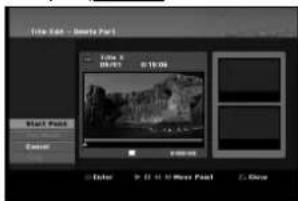
text_image
Time 8 00:00 0:10:00 Start Pads Cancel Video 9:10:46 Movie Pads J2 Group- Starts playback and use pause step, search and slow-motion to find the starting point.
- Press ENTER at the starting point of the section you want to delete. The part is indicated on the Progress Bar. Use ▼ to select [End Point].
- Use pause step, search and slow-motion to find the ending point.
- Press ENTER at the ending point of the section you want to delete. You can cancel the selected point, use ▲ / ▼ to select [Cancel] icon then press ENTER.
- If you finish to edit, select [Done] icon then press ENTER. The confirm message for deleting will appear. Use ◀ / ▶ to select [Ok] then press ENTER. The selected part is deleted from the title and Title List menu appears.
Note:
It may not be possible to delete parts that are less than 3 seconds long.
Naming a Title
You can name Original and Playlist titles independently.
- Choose the title you want to name on the Title List menu, then press ENTER. The menu options appears on the left side of the menu.
- Use ▲/▼ to select [Edit-Title Name] option then press ENTER. Keyboard menu appears.

text_image
Title 3 Alphabet Capital 1 2 3 A B C D E F G H I J K L M N O P Q R S T U V W X Y Z A B D S OK Cancel Space Seconds 4 In Play Chapter Delete Protect Exit Play List Add Enter Off/Playbot Close-
Enter a name for the title. Use ◀/▶/▲/▼ to select a character then press ENTER to confirm your selection.
-
OK: Select to finish.
- Cancel: Cancels all entered characters.
• Space: Inserts a space at the cursor position. -
Delete: Deletes the previous character at the cursor position.
•◀ / ▶: Moves cursor to left or right. -
Choose OK then press ENTER to fix the name and return to the previous menu screen.
- Press RETURN (♂) repeatedly to exit the menu.
Notes:
- For discs formatted on a different recorder, you will see only a limited character set.
- When recording on DVD-R, DVD+R or DVD+RW discs, the entered name is displayed on the DVD player only after finalization.
Dividing One Titles Into Two
+RW
Use this command to split a title up into two new titles.
-
On the Title List menu, select a title you want to divide then press ENTER. The menu options appears on the left side of the screen.
-
Select [Divide] option.

text_image
TIDE LIST V60-V6 V60-200 V70 Play Full Play Inception Delta Project Last Take 1 03/01 Take 2 03/01 Take 3 03/01 Take 4 03/01 Take 5 03/01 Take 6 03/01 Take 7 03/01 Take 8 03/01 Take 9 03/01 Take 10 03/01 Take 11 03/01 Take 12 03/01 Take 13 03/01 Take 14 03/01 Take 15 03/01 Take 16 03/01 Take 17 03/01 Take 18 03/01 Take 19 03/01 Take 20 03/01 Take 21 03/01 Take 22 03/01 Take 23 03/01 Take 24 03/01 Take 25 03/01 Take 26 03/01 Take 27 03/01 Take 28 03/01 Take 29 03/01 Take 30 03/01 Take 31 03/01 Take 32 03/01 Take 33 03/01 Take 34 03/01 Take 35 03/01 Take 36 03/01 Take 37 03/01 Take 38 03/01 Take 39 03/01 Take 40 03/01 Take 41 03/01 Take 42 03/01 Take 43 03/01 Take 44 03/01 Take 45 03/01 Take 46 03/01 Take 47 03/01 Take 48 03/01 Take 49 03/01 Take 50 03/01- Press ENTER.
Edit (Divide) menu appears. [Divide] option is highlighted.
Current picture

text_image
Time 245 - Slade Title 1 03/01 0:00:00 #11 0:00:00 Slade Control $100.00 Ctrl Enter + 10 + 10 Move Packet CloseThe first title's thumbnail
The second title's thumbnail
-
Use play, pause step, search and slow-motion to find the point you want to divide the title.
-
Select [Divide] option then press ENTER at the point. To reset the point, select [Cancel] option then press ENTER. Repeat from step 3.
-
Choose [Done] option then press ENTER to fix the dividing point. The title is divided into two new titles. It take up to 4 minutes to divide.
Note:
You cannot select dividing point less than 3 seconds.
Combining Two Chapters Into
One


Use this function to combine two adjacent Playlist or Original chapters into one.
Note:
This function is not available if there is only one chapter within the title.
-
On the Chapter List menu, select the first chapter of the two chapters you want to combine then press ENTER. The menu options appears on the left side of the screen.
-
Use ▲ / ▼ to select [Combine] option. The combine indicator appears between the two chapters you want to combine.

text_image
Editor List TITLE 2 16/10 Tue DBX11 Play Title Search Edit Preview Add Enter Edit Playlist Clear- Press ENTER.
Moving a Playlist Chapter
VR RAM-R
Use this function to re-arrange the playing order of Playlist chapters on the Title List-Playlist menu.
Note:
This function is not available if there is only one chapter.
- Press MENU / LIST repeatedly to display the Title List-Playlist menu.
- Use ▲▼◀▶ to choose the title you want to view Chapter List-Playlist menu then press ENTER. Title List-Playlist options appears on the left side of the menu.
- Use ▲▼ to select 'Chapter' from Title List-Playlist options then press ENTER. Chapter List-Playlist menu appears on the TV screen.
- Use ▲▼◀▶ to choose the Chapter you want to move.
- Press ENTER. The Chapter List-Playlist options appears on the left side of the menu.
- Use ▲▼◀▶ to select [Edit-Move] option from Chapter List-Playlist options then press ENTER.
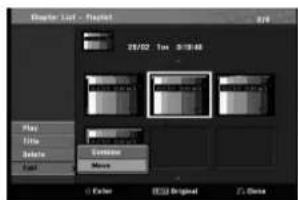
text_image
Project List - Project 2016 25/02 Tue 31/04 Paste Fill Delete Paste Paste Paste Original Delete- Use ▲▼◀▶ to choose the place you want to move the chapter to then press ENTER. After pressing ENTER, the updated menu is displayed.
Hiding a Chapter ■ +R+
You can skip playing chapters without deleting from the disc.
- Use ▲▼◀▶ to choose a chapter you want to hide on the Chapter List menu, then press ENTER. Options appear on the left side of the screen.
- Select [Edit-Hide] option. Example: Chapter List (DVD+RW)

text_image
Maple List TITLE 1 16/18 Box 04/18 Play Issue Set Delete Add Enter 7. Date- Press ENTER to confirm.
Tip
If you select a hidden chapter on the Chapter List menu, you can show it by choosing [Show] option on the menu. After doing that, you are able to see the chapter.
Protecting a Title +R+
Video -R-R N VR RAM-R
Use this function to protect against accidental recording, editing or deleting of the title.
- Press MENU/LIST to display the Title List menu.
- Use ▲▼◀▶ to choose a title you want to protect then press ENTER. Options appear on the left side of the screen.
- Select [Protect] from the options.

text_image
Video List DVR-VS ISO 40.25m Movie Play Full Play Chapter Movie Project Font Image 1 Image 2 Image 3 Image 4 Image 5 Color C:\Scene- Press ENTER to confirm.
The lock mark will appears on the title's thumbnail.
Tip
If you select a title that has already been protected on the Title List menu, you can unprotect it by choosing [Unprotect] option from the Title List menu options. After doing that, you can edit and delete the title.
Reference
Additional Information
Overwriting Recording +RW
To overwrite a new video recording on a previously recorded title, follow these steps. This feature is not available for DVD+Rs, that always record at the end of the Disc.
- Select input source you want to record (TV channel, AV1-3, DV).
- Press MENU/LIST to display the Title List menu.

text_image
00:00 00:50 Free TITLE 1 00:10 TITLE 2 00:11 TITLE 3 00:12 TITLE 4 00:13 TITLE 5 00:14 TITLE 6 00:15 确定 取消- Use ▲▼◀▶ to choose a title you want to overwrite.
- Press REC (●) to start overwrite recording. Overwrite recording starts from the start point of the title.
- Press STOP (■) to stop the overwrite recording. The new title is created and updated menu is displayed.
Notes:
- This function is not available for a protected title.
- If the overwrite is longer than the recording length of the current title, the next title is overwritten. But if next title is protected, the overwriting stops at the starting point of the title.
- If the overwriting recording is shorter than the recording length of the current title, the current title is divided into the overwritten title and the remains of the current title.
- If the selected title's recording length is short, the overwriting may not be operated.
Viewing Title List menu displayed on other DVD Recorders or Players

You can view the Title List menu displayed on the other DVD player that is capable of playing DVD+RW or DVD+R discs.
-
Insert DVD+R or DVD+RW disc recorded already.
-
Press TITLE in play or stop mode. Title List menu will appear as shown below.
Tip
You can close the Title List menu by pressing STOP (■).
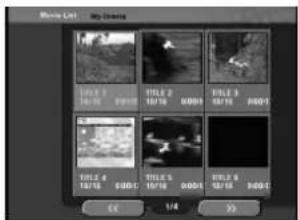
text_image
Movie List My Change 10:13 2 10:15 2 10:17 2 00:01 10:18 3 10:19 3 00:01 10:24 10:16 00:01 10:17 00:01 10:18 00:01 10:19 00:01 10:20 30:01 00 1/4 35- To play back a title, select the title you want then press ENTER or PLAY (▶).
Playing Your Recordings on Other DVD Players (Finalizing a Disc)
Most regular DVD players can play finalized discs recorded in Video mode, finalized DVD+R or DVD+RWs. A small number of players can also play DVD-RW discs recorded in VR mode, finalized or not. Check the manual that came with the other player to check what formats of discs it will play.
Finalizing 'fixes' the recordings and editsings in place so that the disc can be played on a regular DVD player or computer equipped with a suitable DVD-ROM drive.
Finalizing a Video mode disc creates a menu screen for navigating the disc. The menu can be accessed by pressing MENU/LIST or TITLE.
To finalize a disc, refer to "Finalize" on page 22.
Notes:
- Unfinalized DVD+RW is playable on regular DVD players.
- The edited contents of a DVD+RW disc is compatible on regular DVD players only after finalization.
- Any edited contents of the DVD+R disc are not compatible on regular DVD players. (Hide, chapter combine, added chapter mark, etc.)
- How long finalization takes depends on the type of disc, how much is recorded on the disc, and the number of titles on the disc.
- DVD+R DL disc can take up to 30 minutes to finalize.
Language Codes
Use this list to input your desired language for the following initial settings:
Disc Audio, Disc Subtitle, Disc Menu.
| Language | Code | Language | Code | Language | Code | Language | Code |
| Abkhazian | 6566 | Fiji 7074 | Lingala | 7678 | Singhalese | 8373 | |
| Afar 6565 | Finnish | 7073 | Lithuanian | 7684 | Slovak 8375 | ||
| Afrikaans | 6570 | French | 7082 | Macedonian | 7775 | Slovenian | 8376 |
| Albanian | 8381 | Frisian 7089 | Malagasy | 7771 | Somali 8379 | ||
| Ameharic | 6577 | Galician | 7176 | Malay 7783 | Spanish | 6983 | |
| Arabic | 6582 | Georgian | 7565 | Malayalam | 7776 | Sudanese | 8385 |
| Armenian | 7289 | German | 6869 | Maltese | 7784 | Swahili | 8387 |
| Assamese | 6583 | Greek | 6976 | Maori | 7773 | Swedish | 8386 |
| Aymara | 6588 | Greenlandic | 7576 | Marathi 7782 | Tagalog | 8476 | |
| Azerbaijani | 6590 | Guarani | 7178 | Moldavian | 7779 | Tajik | 8471 |
| Bashkir 6665 | Gujarati | 7185 | Mongolian | 7778 | Tamil | 8465 | |
| Basque | 6985 | Hausa | 7265 | Nauru | 7865 | Tatar 8484 | |
| Bengali; Bangla | 6678 | Hebrew | 7387 | Nepali | 7869 | Telugu | 8469 |
| Bhutani | 6890 | Hindi 7273 | Norwegian | 7879 | Thai | 8472 | |
| Bihari | 6672 | Hungarian | 7285 | Oriya | 7982 | Tibetan 6679 | |
| Breton | 6682 | Icelandic 7383 | Panjabi 8065 | Tigrinya | 8473 | ||
| Bulgarian | 6671 | Indonesian | 7378 | Pashto, Pushto | 8083 | Tonga | 8479 |
| Burmese 7789 | Interlingua | 7365 | Persian | 7065 | Turkish 8482 | ||
| Byelorussian | 6669 | Irish 7165 | Polish | 8076 | Turkmen 8475 | ||
| Cambodian | 7577 | Italian 7384 | Portuguese | 8084 | Twi | 8487 | |
| Catalan | 6765 | Japanese | 7465 | Quechua | 8185 | Ukrainian | 8575 |
| Chinese 9072 | Javanese | 7487 | Rhaeto-Romance | 8277 | Urdu | 8582 | |
| Corsican 6779 | Kannada 7578 | Rumanian | 8279 | Uzbek | 8590 | ||
| Croatian | 7282 | Kashmiri | 7583 | Russian | 8285 | Vietnamese | 8673 |
| Czech | 6783 | Kazakh 7575 | Samoan 8377 | Volapuk | 8679 | ||
| Danish | 6865 | Kirghiz 7589 | Sanskrit | 8365 | Welsh | 6789 | |
| Dutch 7876 | Korean | 7579 | Scots Gaelic | 7168 | Wolof | 8779 | |
| English 6978 | Kurdish | 7585 | Serbian | 8382 | Xhosa | 8872 | |
| Esperanto | 6979 | Laothian | 7679 | Serbo-Croatian | 8372 | Yiddish 7473 | |
| Estonian | 6984 | Latin | 7665 | Shona | 8378 | Yoruba | 8979 |
| Faroese 7079 | Latvian, Lettish | 7686 | Sindhi | 8368 | Zulu | 9085 |
Area Codes
Choose an area code from this list.
| Area Code | Area Code | Area Code | Area Code | ||||
| Afghanistan AF | Ethiopia ET | Malaysia | MY | Saudi Arabia | SA | ||
| Argentina AR | Fiji | FJ | Maldives | MV | Senegal | SN | |
| Australia AU | Finland FI | Mexico MX | Singapore SG | ||||
| Austria AT | France FR | Monaco | MC | Slovak Republic | SK | ||
| Belgium BE | Germany | DE | Mongolia | MN | Slovenia | SI | |
| Bhutan BI | Great Britain | GB | Morocco MA | South Africa | ZA | ||
| Bolivia BO | Greece | GR | Nepal NP | South Korea | KR | ||
| Brazil BR | Greenland | GL | Netherlands | NL | Spain ES | ||
| Cambodia KH | Heard and McDonald Islands | HM | Netherlands Antilles | AN | Sri Lanka | LK | |
| Canada CA | Hungary | HU | New Zealand | NZ | Sweden SE | ||
| Chile CL | India | IN | Nigeria NG | Switzerland CH | |||
| China CN | Indonesia | ID | Norway | NO | Thailand | TH | |
| Colombia CO | Israel | IL | Oman | OM | Turkey TR | ||
| Congo CG | Italy | IT | Pakistan | PK | Uganda UG | ||
| Costa Rica CR | Jamaica | JM | Panama | PA | Ukraine | UA | |
| Croatia HR | Japan JP | Paraguay PY | United States | US | |||
| Czech Republic | CZ | Kenya KE | Philippines | PH | Uruguay | UY | |
| Denmark | DK | Kuwait KW | Poland PL | Uzbekistan UZ | |||
| Ecuador | EC | Libya | LY | Portugal | PT | Vietnam | VN |
| Egypt | EG | Luxembourg | LU | Romania | RO | Zimbabwe | ZW |
| El Salvador | SV | Russian Federation | RU | ||||
Operation with KARAOKE
You can enjoy karaoke function with karaoke disc by connecting a microphone to the unit.
Karaoke Basic Playback
- Check if the system is connected. (Refer to the page 11-12.)
- Turn on the powers of TV (or Amplifier) and the unit and enter to the video mode on TV.
- Press ▲ OPEN/CLOSE to open the disc tray and load the supplied karaoke disc in the tray with the label facing up.
- Press ▲ OPEN/CLOSE to close the tray. In (TV)DVD mode, the unit enters to the karaoke mode automatically.
[TV Screen]

text_image
KAPAOKE YOU! YOU IT ON WORK- Connect the microphone to the MIC 1 or MIC 2 jack.
- Select the melody number you want by pressing NUMERIC buttons. If you cancel the selected melody number, press CLEAR.
- Press PLAY or ENTER. The selected melody number is played.
Notes:
- The TEMPO(-/+), KEY CON(b/#), SHADOW, and S2V buttons are available only during karaoke mode.
- The microphone output from DIGITAL AUDIO OUT jacks is not available.
Karaoke Advanced Playback
S2V (Sound2Vision)\_SCORE Function
- S2V (Sound2Vision) : S2V shows music visuals using sound of karaoke music and voice.
- SCORE: SCORE shows the song score in real time with the tone and rhythm level meter.

text_image
Tone S2V 80 Score Rhythm- Press S2V.

text_image
Street photo with visible store signboards and digital display screens showing '80% Even' and '100% Even'- You can select an item by pressing ▲ / ▼ and change or select the setting by pressing ◀ / ▶ then press ENTER.
• Визуализация эвука: Selects source to visualize between echo. голос
Selects Выкл to deactivate.
- Режим визуализации: Selects the visualization that you want to view.
• Подсчет очков : Selects the level.
Selects Выкл to deactivate.
Return Function
This is a function that returns to the preceding menu. Press RETURN.
Note:
If there is no preceding menu (in case of the first menu), this function may not be executed.
To Adjust MIC Volume
Press MIC VOL. (- / +) on the remote control or VOL.(+) on the front panel to increase the volume, or VOL.(-) to decrease it.
To Adjust ECHO Mode
You can give an echo effect to the sound from the microphones.
Press ECHO MODE on the remote control repeatedly to set ECHO MIN, 1, 2, MAX.
Key Control
You can change the key to suit your vocal range. You can adjust the key to 13 steps (6 steps higher, 6 steps lower and the original key).
- The setting appears on the screen.
Press KEY CON (b/#) repeatedly on the remote control to find the key that suits your vocal range.
- To flatten the key one by one, press the KEY CON (b) repeatedly during playback.
- To sharp the key one by one, press the KEY CON (#) repeatedly during playback.
- To return to the original key, press the KEY CON (b/#) repeatedly to appear the original key.
Male/Female Function
If you want to sing a song of men's or women's key, press MALE/FEMALE repeatedly to change men's or women's key.
Tempo Change
You can use this function when you want to play fast or slowly.
- Press TEMPO (+) repeatedly during singing to play fast.
- Press TEMPO (-) repeatedly during singing to play slowly.
Reserving the Songs
When you want to make a reservation of next melody, you can enjoy up to 12 melodies reservation without waiting.
- Press the NUMERIC buttons to reserve melody number you want in the karaoke disc. Melody number appears on the TV screen.
- Press PROGRAM. The melody number is made a reservation.
- Repeat steps 1-2. You can reserve 12 songs.
Tip:
After the one song finishes its playback, the next song will be play back automatically.
To cancel the reserved song
Each time you press CLEAR, the reserved song will be cancelled one by one.
To cancel or change the wrong reserved song
Press PROGRAM to move to the desired position, then press CLEAR to cancel the reserved song.
Shadow Function
If background image and the song's subtitle are mixed up, the song's subtitle may be invisible. In this case, to highlight the song's subtitle, press SHADOW.
- It will be highlighted by background shadow image.
Karaoke Menu Playback
Preparation
Press MENU/LIST on the karaoke mode. The main menu appears on the screen.
text_image
1. УСТАНОВКИ 2. СПИСОК КОМПОЗИЦИЙ 3. СЛУЧАЙНЫЙ ВЫБОР 4. СОРЕВНОВАНИЕSETUP ()становки
- Select 1. установки by pressing ▲ / ▼ on the main menu.
- Use ◀/▶ to select the desired option, and press ENTER.
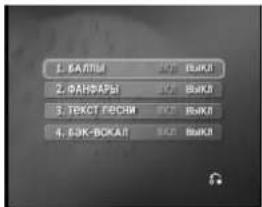
text_image
1. БАЛЛИМ 2. ФАНРАРЫ 3. ТЕКСТ ГЕСИМ 4. БЭК-ВОКАЛSCORE ON/OFF ( ). БАЛЛЫ
BK.1: When singing by selection of melody, song score comes out after one piece of song is ended.
To cancel it, select the ВЫКЛ
FANFARE ON/OFF ( ). ФАНФАРЫ
BKT: When the singing a song ends normally without stopping midway, scoring fanfare operates. The fanfare sound comes out after singing finished.
To cancel it, select the ВЫКЛ
BKJ: When singing by selection of melody, song lyric appears on the TV screen.
To cancel it, select the ВЫКЛ
CHORUS ON/OFF (1). БЭК-ВОКАЛ
BKJ: When singing by selection of melody, song chorus is heard a sound.
To cancel it, select the ВЫКЛ
Notes:
• To move to the main menu, press MENU/LIST.
- To exit the main menu, press MENU/LIST.
MUSIC LIST (ОПИСОК КОМПОЗИЦИЙ)
LOCAL SONG () and POPUE PESCHI
SONG (1). ЗАРУБЕЖНЫЕ ПЕСНИ
- Select by pressing the
▲ / ▼ on the main menu.
The LOCAL SONG, POP SONG and CLASSIC menu will be shown on the TV screen.

by pressing the ▲ / ▼, and press ENTER. SONG LIST and SINGER LIST menu will be shown on the TV screen.
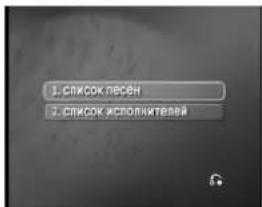
text_image
1. СПИСОК ПЕСЕН 2. СПИСОК ИСПОНИТЕЛЕЙ1 Select and select the initial of the song title you want by pressing the ▲ / ▼, then press ENTER.
2 Select the song title you want by pressing the ▲ / ▼, and press ENTER.

text_image
СПИСОК ПЕСЕН 150 10 1000 MHz 1500 10 KAREL 1500 110V 1000 12-28E-06 1700 17 AEN CVRAS... TANER... APPRO... XAMEX... NAPR переменование @ audio1 Select and select the initial of the singer you want by pressing the ▲ / ▼, then press ENTER.
text_image
список исполнителей + - - - - - - - - - - - - - - + - + - + - + - + - + - + - + - + - + - + - + - + - + - + - + - + - + - + - + - + - + - + - + - + - + - + - + - + - + - + - + - + - + - + - + - + - + - + - + - + - + - + - + - + - + - + - + - + - + - + + + + + + + + + + + + + + + + + + + + + + + + + + + + + + + + + + + + + + + + + + + + + + + + + + + пеняжение выбор2 Select the singer you want by pressing the ▲ / ▼, and press ENTER.
3 Select the song title you want by pressing the ▲ / ▼, and press ENTER.

text_image
СПИСОК ИСПОЛНИТЕЛЕЙ КИЙ КРЕВАНИЕ ИСПОЛНИТЕЛЬ 1021 BEZ TEES 140 VEA... 1022 WAP BA 140 VEA... 1023 SA ELECTRICATION 140 VEA... 1024 ON ON 140 VEA... 1025 A BUY SEBAT... 140 VEA... 1026 A CUSTAVI ON T... 140 VEA... Нереминация @ выборNotes:
• To move to the previous mode, select the by
pressing the ▲ / ▼, then press ENTER.
- Press ◀ / ▶ to move to the previous or next page.
1. Select by pressing the
▲ / ▼, and press ENTER.
The CLASSIC LIST and COMPOSER LIST menu will be shown on the TV screen.

text_image
1. СТИСОК КОМПО ЗИЦИЙ 2. СТИСОК КОМПО ЗИТОРДБCLASSIC LIST ( ). СПИСОК КОМПОЗИЦИЙ
- Select and select the initial of the song title you want by pressing the ▲/▼, then press ENTER.
- Select the song title you want by pressing the ▲/▼, and press ENTER.

text_image
СПИСОК. КОМПОЗИЦИЙ КУМ. НОВЕНИЯ КОМПОЗИТОР 1000 АБОНТ, ЕРЕЖЕН БАЛ., SCHWALN 1000 АНЧ, НОВЕНИЯ, CHINE 1000 АБОНТ, ТНО, СТАГО, SCHWALN 1000 АНЧТА, ВЕНДО, C., WENJELSON 1000 АНТАТА'S РОССЕ, Г., CHINE 1000 АНАБЫСКЕ УК. 20, SCHWALN 1000 АНАБЫСКЕ УК. 1, И. Г. ОБОУСЬ 1000 АНАБЫСКЕ УК. 2, И. Г. ОБОУСЬ Тереминация @ выборCOMPOSER LIST ( ). СПИСОК КОМПОЗИТОРОВ
- Select and select the initial of the composer you want by pressing the ▲ / ▼ in the CLASSIC LIST and COMPOSER LIST menu, and press ENTER.

- Select the composer you want by pressing the ▲ / ▼, and press ENTER.
- Select the song title you want by pressing the ▲ / ▼, and press ENTER.

text_image
СПИСОК КОМПОЗИТОРОВ КИМПОЗИТОР 1014 BACATELL GE 11 MO 8 BEETHUVEI 1015 BACATELL GE 13 MO 9 BEETHUVEI 1016 FIER OLISE 1017 WMALIGOT SONATA . BEETHUVEI 1018 WMALIGOT SONATA . BEETHUVEI 1019 WMALIGOT SONATA . BEETHUVEI 1020 FATHEITIQUE SONATA . BEETHUVEI 1021 FATHEITIQUE SONATA . BEETHUVEINotes:
- To move to the previous mode, select the by pressing the ▲ / ▼, then press ENTER.
- Press ◀ / ▶ to move to the previous or next page.
- Press ENTER to begin randomly.
CHALLENGE (СОРЕВНОВАНИЕ)
It has a function which enjoy a song game dividing into the red and blue teams.
- Select 4. СОРЕВНОВАНИЕ by pressing ▲ / ▼ on the main menu.
It appears as below.
▲ / ▼, and select one of NUMERIC buttons 1\~9 by pressing ◀ / ▶ to set number to win, then press ENTER.
- Select by pressing результат
▲ / ▼, and select one of 60,70,80 or 90 by pressing ◀ / ▶ to set challenge score, then press ENTER.
- Select CTAPT by pressing ▲ / ▼, then press ENTER.
It appears as below.
text_image
1 2 3 4 5 6 7 8 9 10 11 12 13 14 15 16 17 18 19 20-
Select number you want by pressing ▲ / ▼ and press ENTER. Sing along with the accompaniment.
-
Repeat step 5. Alternate between the red and blue teams.
-
When reaching the targeted winning number, the R03UPABITOM will be shown on the TV screen. It appears as below.

text_image
ПОЗДРАВЛЕМ- Whether you keep going the song game or not, select 1, DA or 2, HET by pressing ▲/▼ as below.
You can play the karaoke songs downloaded on internet.
(Refer to the Karaoke Registration on page 20)
-
Repeat the steps 1-2 of the Karaoke Basic Playback on the page 48.
-
Press HOME and the Home menu appears.
-
Select [KARAOKE] and then one media (DISC(CD-R/CD-RW)/USB) containing the downloaded karaoke files.
text_image
FIRE USBTip:
In internet karaoke mode, you can use only the discs (CD-R/CD-RW) containing the downloaded karaoke files (See the page 20).
- After the message "Preparing" pops up, the Karaoke file list appears.
It displays folder/file names consisting of the .LGK file extensions.
Notes:
When there are more than 500 files in media, it may take long to enter the karaoke file list.
text_image
NOS List USB Systems Documents BD— H880— Registration Code_TLPX1UP SEPT1 SEPT2 ODOT,WOR,LOR- Use ▲▼ to select a web karaoke file you want and then press ENTER. You can play or edit karaoke files.
• [Open] Opens the folder and a list of files
• [Play] Starts playback the selected title
Notes:
- If you press DISPLAY instead of ENTER after selecting a desired file, you can check the number and information of the song file.

text_image
001/004 System Remarks 1 001 AEB LCK Song Number 10001 Title: 1.05.00 001 AEB LCK Order 238 Mark 24Close- Select [Play] and press ENTER, playback starts
text_image
00 Време неда ТОЛЬКО ЗВЕЗДИ- When the Karaoke Registration Code is not correct, the message "Karaoke Registration Code Is Not Correct." appears.

text_image
Karaoke Registration Code Is Not Correct OKInternet Karaoke Advanced Playback
- When a song starts playing, the images in an input mode you previously set before entering the internet karaoke mode is displayed as the back ground ones.
Note:
In case that you set the input mode to DV, the images in TV mode is displayed as the background ones.
- When you press AV on the remote control, the input mode you previously set is changed into the next mode. (For example, when you set the mode into AV2 and press button once, the mode is changed into AV3. Input modes are changed in the following order: AV1→AV2→AV3→TV→AV1...)
- By pressing the button repeatedly, you can select a desired input mode and see the images in that input mode as the background ones.

- The functions like S2V and Score (Refer to the page 48), and Key Control and Tempo Change(Refer to the page 49) functions are supported.
- In internet karaoke mode, the default setting for Score/Fanfare/ Lyric/ Chros functions is set to On. That is, unlike Karaoke basic playback, you cannot change the setting to Off.
Reserving songs
- Press MENU/LIST on the remote control, and the file list appears on the TV screen.

text_image
2014E_Venter_Inks.LDK 28400_Konya_Inks.LDK 2019A_Ly_sharkesh.LDK 28402_Gye_zhu_yy_ges.LDK 20175_Morkevsky_Inks.LDK Rave neda TOJько звезди-
Select a song file you want to reserve.
-
Press PROGRAM or ENTER on the remote control. The melody number is made a reservation and displayed on the upper part of the screen.

text_image
19501 19502 19503 19503 19503 19503 19503 19503 19503 19503 00 Вяленки валенки ОХ НИЕ ПОСН ДЕЯКЛИ ЗОЛЕН- Repeat steps 1-2. You can reserve 10 songs.
Tip:
- When you reserve some songs and press STOP, the reserved song will be played back automatically. But when you does not reserve any songs and press STOP, you will return to the karaoke file list.
• You can reserve songs only during playback.
Controlling Your TV with the Supplied Remote Control
You can control the sound level, input source, and power switch of your LG/GoldStar TV with the supplied remote.
-
While holding down TV POWER button, press PR + or -.
-
Release TV POWER button.
You can control your TV using the buttons below.

text_image
7 CLEAR 8 0 9 PROGRAM TV control buttons TV POWER PR VCL INPUT -By pressing You can
POWER Turn the TV on or off.
INPUT Switch the TV's input source between the TV and other input sources.
PR +/- Scans up or down through memorized channels.
VOL +/- Adjust the volume of the TV.
Note:
When you replace the batteries of the remote, you may have reset the remote control.
Troubleshooting
Check the following guide for the possible cause of a problem before contacting service.
| Symptom | Cause | Solution |
| No power. | The power cord is disconnected. | Plug the power cord into the wall outlet securely. |
| No picture. | The TV is not set to receive recorder signal output. | Select the appropriate video input mode on the TV so the picture from the recorder appears on the TV screen. |
| The video cable is not connected securely. | Connect the video cable securely. | |
| The connected TV power is turned off. | Turn on the TV. | |
| No sound. | The equipment connected with the audio cable is not set to receive recorder signal output. | Select the correct input mode on the audio receiver so you can listen to the sound from the recorder. |
| The audio cables are not connected securely. | Connect the audio cable securely. | |
| The power of the equipment connected with the audio cable is turned off. | Turn on the equipment connected with the audio cable. | |
| The audio connecting cord is damaged. | Replace it with new one. | |
| The playback picture is poor. | The disc is dirty. | Clean the disc. |
| The recorder does not start playback. | No disc is inserted. | Insert a disc. (Check that the disc indicator in the display window is lit.) |
| An unplayable disc is inserted. | Insert a playable disc. (Check the disc type, color system, and regional code.) | |
| The disc is placed upside down. | Place the disc with the playback side down. | |
| The disc is not placed within the guide. | Place the disc on the disc tray correctly inside the guide. | |
| The disc is dirty. | Clean the disc. | |
| The Rating level is set. | Cancel the Rating function or change the rating level. | |
| The picture from the external input is distorted | The video signal from the external component is copy-protected. | You cannot connect via this recorder. Connect the component directly to your TV. |
| Some channels are skipped over when using ▲ / ▼. | Those channels are not stored in the recorder. | Restore channels. See “Program Edit” on page 16. |
| The picture or sound of broadcasting channel is weak or missing. | Aerial or cables are loose. | Tighten connections or replace cable. |
| Camcorder image is not shown. | Camcorder is off. | Turn camcorder on and operate properly. |
| Camcorder image via A/V input or DV IN to recorder is not shown on TV screen. | The recorder's source is incorrect. | Use AV to select input channel (AV1, AV2, DV, etc.) |
| Cannot play a disc recorded using this recorder on another player. | The disc was recorded in Video mode. | Finalize the disc. (page 22) |
| Some players will not play even a finalized disc recorded in Video mode. | No solution. | |
| The disc was recorded in VR mode, | The other player must be RW compatible in order to play it. | |
| Discs recorded with copy-once material cannot be played on other players. | No solution. | |
| Cannot record or did not record successfully. | The remaining blank space on the disc is insufficient. | Use another disc. |
| The source you are trying to record is copy protected. | You cannot record the source. | |
| When setting the recording channel, the channel is tuned on the TV's own tuner. | Select the channel on the recorder's built-in TV tuner. | |
| When recording to a Video mode disc, programs that are copy-once protected cannot be recorded. | Use a VR mode formatted disc for copy-once material. | |
| Timer recording is not possible. | Clock in recorder is not set to correct time. | Set clock to correct time. See "Clock Set" on page 17. |
| Timer has been programmed incorrectly. | Reprogram Timer. See "Timer Recording" on page 36. | |
| Timer record indicator light does not appear after programming timer. | Reprogram Timer. | |
| Stereo Audio Record and/or Playback is not present. | TV is not Stereo-compatible. | No solution. |
| Broadcast program is not in stereo format. | No solution. | |
| The recorder A/V Out jacks are not connected to TV A/V In jacks. | Make A/V connections. Stereo is available only via A/V output from the recorder. | |
| The recorder Audio/Video Out is not selected for viewing at the TV. | Select AUX or A/V source as TV input. | |
| The recorder's TV audio channel is set to mono. | Set TV audio channel mode to Stereo. See "Changing TV audio channel" on page 35. | |
| The remote control does not work properly. | The remote control is not pointed at the remote sensor of the recorder. | Point the remote control at the remote sensor of the recorder. |
| The remote control is too far from the recorder. | Operate the remote control within 7 m. | |
| There is an obstacle in the path of the remote control and the recorder. | Remove the obstacle. | |
| The batteries in the remote control are exhausted. | Replace the batteries with new ones. |
Resetting the recorder
If you observe any of the following symptoms...
- The unit is plugged in, but the power will not turn on or off.
• The front panel display is not working.
• The recorder is not operating normally.
...you can reset the recorder as follows:
- Press and hold the POWER button for at least five seconds. This will force the unit to power off then turn the unit back on.
- Unplug the power cord, wait at least five seconds, and then plug it in again.
Specifications
General
Power requirements AC 200-240V, 50/60 Hz
Power consumption 35W
Dimensions (approx.) 441 X 58 X 307 mm (w x h x d) without foot
Mass (approx.) 3.92 kg
Operating temperature 5°C to 35°C
Operating humidity 5 % to 90 %
Television system PAL I, B/G, I/I, SECAM D/K, K1 colour system
Recording format PAL
Recording
Recording format DVD Video Recording, DVD-VIDEO
Recordable media DVD-ReWritable, DVD-Recordable, DVD+ReWritable, DVD+Recordable, DVD+Recordable (Double Layer), DVD-RAM
Recordable time DVD (4.7GB): Approx. 1 hour (XP mode), 2 hours (SP mode),
4 hours (LP mode), 6 hours (EP mode)
DVD+R DL (8.5GB): Approx. 2 hours (XP mode), 4 hours (SP mode),
8 hours (LP mode), 12 hours (EP mode)
Video recording format
Sampling frequency 27MHz
Compression format MPEG2
Audio recording format
Sampling frequency 48kHz
Compression format Dolby Digital
Playback
Frequency response DVD (PCM 48 kHz): 8 Hz to 20 kHz, CD: 8 Hz to 20 kHz
DVD (PCM 96 kHz): 8 Hz to 44 kHz
Signal-to-noise ratio More than 100 dB (AUDIO OUT connector)
Harmonic distortion Less than 0.008% (AUDIO OUT connector)
Dynamic range More than 95 dB (AUDIO OUT connector)
Inputs
AERIAL IN Aerial input, 75 ohms
VIDEO IN 1.0 Vp-p 75 ohms, sync negative, RCA jack x 1 / 2 SCART
AUDIO IN 0 dBm more than 47 kohms, RCA jack (L, R) x 1 / 2 SCART
DV IN 4 pin (IEEE 1394 standard)
Outputs
VIDEO OUT 1 Vp-p 75 Ω, sync negative, RCA jack x 1 / 2 SCART
COMPONENT VIDEO OUT (Y) 1.0 V (p-p), 75 Ω, negative sync, RCA jack x 1
(Pb)/(Pr) 0.7 V (p-p), 75 Ω, RCA jack x 2
Audio output (digital audio) 0.5 V (p-p), 75 Ω, RCA jack x 1
Audio output (optical audio) 3 V (p-p), 75 Ω, Optical connector x 1
Audio output (analog audio) 2.0 Vrms (1 KHz, 0 dB), 600 Ω, RCA jack (L, R) x 1 / 2 SCART
- Designs and specifications are subject to change without notice for improvement.